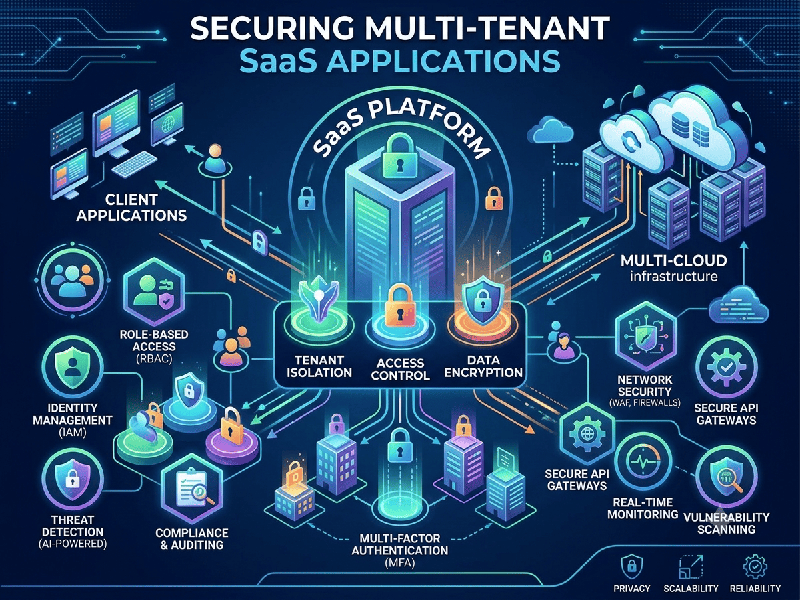
Securing Multi-Tenant SaaS Applications
Securing a multi-tenant SaaS application is
fundamentally about preventing "cross-talk"—ensuring that even
though multiple customers (tenants) share the same underlying infrastructure,
they remain logically or physically isolated from one another.
To secure these systems effectively, you must focus on
four core pillars of architecture and operations.
1. Data Isolation Strategies
This is the most critical layer. You must choose an
isolation model that balances your security requirements with your operational
budget:
- Shared Schema (Logical
Isolation): All
tenants live in the same tables. You use a tenant_id column to filter
data.
o Security Tip: Never rely on your application code
alone to filter by tenant_id. Use database-level Row Level Security (RLS)
(e.g., in PostgreSQL) to ensure the database itself blocks unauthorized
cross-tenant queries.
- Schema-per-Tenant: Tenants share a database
instance but have their own separate schemas. This provides stronger
logical separation and makes backups/restores easier.
- Database-per-Tenant: The highest level of isolation.
Each tenant has a completely separate database instance. This is often
required for enterprise or highly regulated (HIPAA/GDPR) clients.
2. Tenant Context Propagation
A common vulnerability is "Broken Access
Control," where a request is authorized, but not correctly scoped to the
specific tenant.
- The Golden Rule: Every request entering your
system must establish tenant context immediately at the API Gateway
or authentication layer.
- Contextual Integrity: This tenant_id must be passed
down through every layer—services, database queries, background jobs, and
even logs—to ensure no process ever acts on the wrong data.
- Never Trust Client Input: Do not infer the tenant from a
URL parameter or hidden form field supplied by the client. Extract the
tenant_id from a secure, server-side verified JWT (JSON Web Token) claim.
3. Hardening Authentication & Sessions
Multi-tenant environments are high-value targets for
credential stuffing and session hijacking.
- Avoid LocalStorage: Never store sensitive session
tokens in browser localStorage or sessionStorage, as these are vulnerable
to Cross-Site Scripting (XSS).
- Use Secure Cookies: Use HttpOnly, Secure, and
SameSite=Strict cookies to store session information.
- Adaptive MFA: Implement Multi-Factor
Authentication that adapts to risk signals (e.g., unusual login location
or new device).
4. Resource Governance (The "Noisy Neighbor"
Problem)
Security isn't just about data leaks; it's also about
service availability. If one tenant runs a massive, unoptimized query, it
shouldn't crash the system for everyone else.
- Rate Limiting & Quotas: Enforce strict API rate limits
and database query budgets per tenant.
- Priority Queuing: Use dedicated background worker
pools for enterprise tenants so their tasks aren't blocked by a
"noisy neighbor" on a free-tier plan.
- Tenant-Aware Logging: Ensure every log entry is
tagged with the tenant_id. If a breach or performance issue occurs, you
need to be able to isolate which tenant was affected without sifting
through noise from hundreds of other customers.