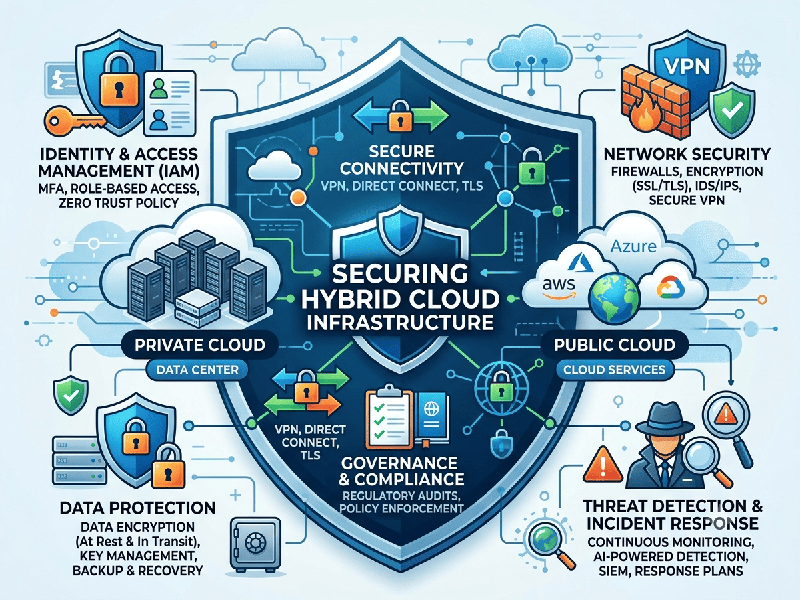
Securing Hybrid Cloud Infrastructure
Securing a
hybrid cloud infrastructure requires unifying security controls across
on-premises data centers, private clouds, and public cloud environments (AWS,
Azure, GCP). Because perimeter-based security fails in fragmented setups,
enterprise hybrid cloud protection relies on a Zero Trust architecture,
centralized visibility, and continuous compliance automation.
• Palo
Alto Prisma Cloud
• Orca
Security | | Hybrid Identity & Access Management (IAM) |
Enforces centralized Single Sign-On (SSO), Multi-Factor Authentication (MFA),
and Least Privilege Access across both legacy and cloud workloads. | • Microsoft
Entra ID (Azure AD)
• Okta
Identity Cloud
• Ping
Identity | | Cloud Workload Protection (CWPP) | Secures containers,
virtual machines, serverless functions, and microservices across hybrid hosts
against runtime threats. |
• Trend
Micro Cloud One
• CrowdStrike
Falcon Cloud Security
• Defender
for Cloud | | Network & Microsegmentation | Restricts lateral
movement between on-prem servers and public cloud instances using encrypted
tunnels (IPsec/DirectConnect) and Software-Defined Perimeters. | • Zscaler
Private Access (ZPA)
• Illumio
• Cisco
Secure Firewall / Tetration | | Unified SIEM / XDR Monitoring |
Centralizes log ingestion, threat intelligence, and behavioral analytics across
all hybrid environments for real-time incident response. | • Microsoft
Sentinel
• Splunk Enterprise Security
• Datadog
Security Monitoring |
Core Best
Practices
- Enforce Zero Trust Principles: Assume breach across all
segments. Require explicit verification ("never trust, always
verify") for every user, device, and network transaction regardless
of location.
- Standardize Infrastructure as
Code (IaC) Scanning: Integrate tools like Checkov or tfsec into CI/CD pipelines to catch
security vulnerabilities before deploying configurations into production.
- Encrypt Data in Transit and at
Rest: Manage
encryption keys via centralized Key Management Services (KMS) or Hardware
Security Modules (HSM) to ensure compliance and data sovereignty.
- Automate Patching &
Vulnerability Management: Maintain consistent vulnerability scanning for legacy
on-prem systems and containerized cloud applications to prevent drift.