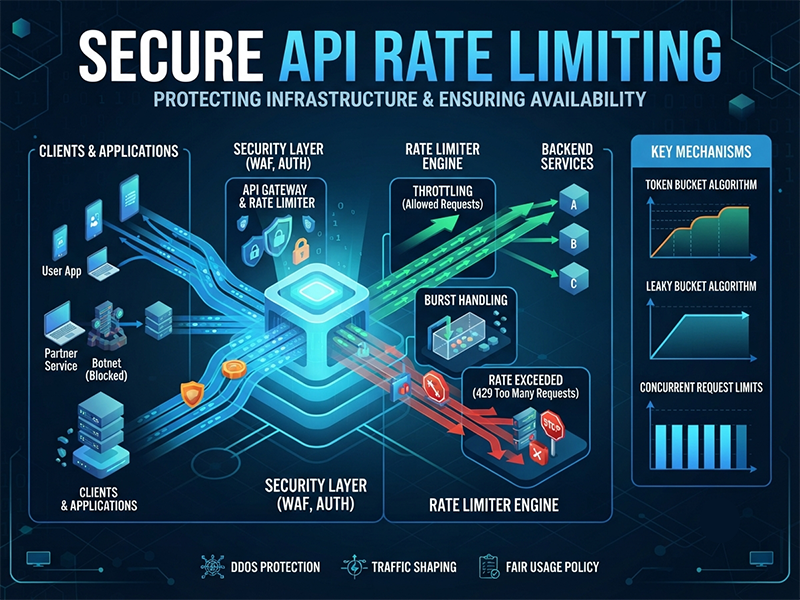
Secure API Rate Limiting
Secure API rate limiting is a critical cybersecurity and
traffic-management practice used to control the number of requests a user,
client application, or IP address can make to an API within a specified time
window. When implemented securely, it acts as a primary defense mechanism
against Distributed Denial of Service (DDoS) attacks, brute-force login
attempts, web scraping, and accidental server overload.
Why Secure Rate Limiting Matters
- Mitigates Abuse & Botnets: Prevents malicious actors from
overwhelming resource-intensive endpoints (like search algorithms,
authentication routes, or heavy database queries).
- Ensures Fair Resource
Allocation:
Stops a single malfunctioning client script or aggressive user from
starving resources and degrading performance for other users.
- Controls Operational Costs: Essential for cloud-native
architectures and APIs interacting with paid third-party models (such as
Generative AI inference) where runaway loops can incur massive bills.
Core Rate Limiting Algorithms
1.
Token Bucket:
Allows a maximum capacity of tokens in a "bucket." Tokens refill at a
steady rate. Each request consumes a token, making it ideal for handling normal
traffic bursts.
2.
Leaky Bucket:
Queues incoming requests and processes them at a strictly constant, predictable
rate. Any excess requests overflow and are dropped or delayed, ensuring smooth
server loads.
3.
Fixed Window:
Counts requests within rigid time intervals (e.g., 100 requests per minute).
While simple to implement, it is vulnerable to boundary spikes (where a user
exhausts their limit at the very end of one window and the beginning of the
next).
4.
Sliding Window:
Tracks requests on a rolling time basis or via a hybrid counter to eliminate
boundary burst vulnerabilities, providing smoother traffic control.
Best Practices for Secure Implementation
- Granular Client Identification: Rely on authenticated tokens,
API keys, or JSON Web Tokens (JWT) rather than raw IP addresses whenever
possible to avoid penalizing legitimate users sharing a corporate network
or public Wi-Fi.
- Tiered & Resource-Based
Limits: Apply
stricter caps to high-cost or sensitive endpoints (like /login, password
resets, or file uploads) while allowing more flexible thresholds for
low-cost read operations.
- Standardized HTTP Responses: When a limit is breached,
reject the request with a standard 429 Too Many Requests status
code. Include descriptive response headers (X-RateLimit-Limit,
X-RateLimit-Remaining, and X-RateLimit-Reset) so clients know when they
can resume activity.
- Distributed State Storage: Use high-performance, in-memory
data stores like Redis to track request counters globally, ensuring
rate limits are accurately enforced across multiple clustered API gateway
instances.