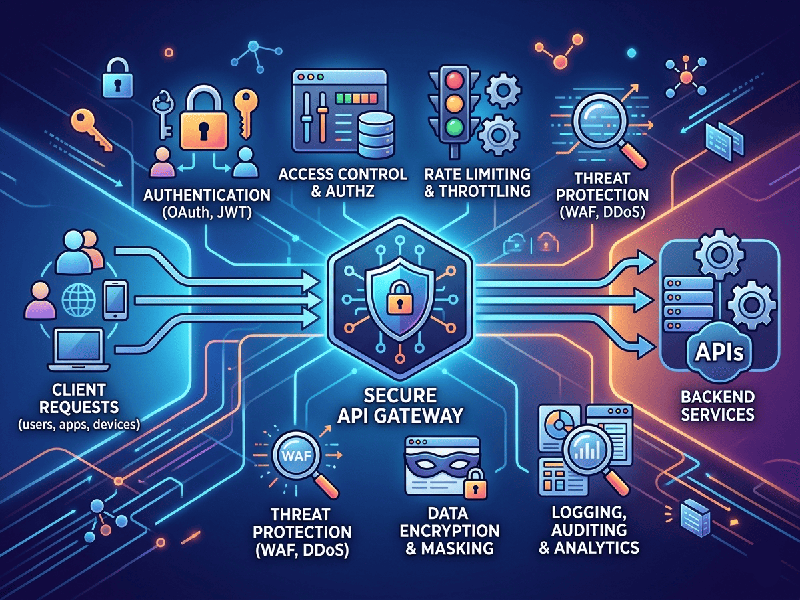
Secure API Gateway Architecture
An API Gateway is the front door to an enterprise’s
microservices and internal applications. Because it handles 100% of incoming
external traffic, it is the primary target for attackers.
A Secure API Gateway Architecture moves security
enforcement to the absolute edge of your network, ensuring malicious or
unauthenticated requests are intercepted and blocked before they can ever reach
down-stream business logic.
1. Zero Trust Edge Perimeter Layout
In a secure enterprise architecture, the API Gateway operates
inside a Demilitarized Zone (DMZ) or edge network. It acts as a strict policy
decision and enforcement point.
- Public Edge Protection: Web Application Firewalls
(WAFs) sit in front of the gateway to scrub traffic of cross-site
scripting (XSS), SQL injections, and massive DDoS attacks.
- The Gateway Shield: The gateway handles
authentication, decrypts identity tokens, runs threat scans, and checks
rate limits.
- Downstream Isolation: Downstream microservices sit
entirely in isolated private subnets, trusting only requests that
carry a cryptographic signature or token verified by the gateway.
2. Five Critical Pillars of Gateway Security
1. Token-Based Authentication &
Scope Authorization
- OAuth 2.0 & OIDC: The gateway should never handle
raw usernames or passwords. Instead, clients present cryptographically
signed JSON Web Tokens (JWTs) or opaque access tokens issued by a
centralized Identity Provider (IdP).
- Token Offloading: The gateway validates the
token's signature, expiration, and issuer. It checks the token's scopes
(e.g., read:orders, write:payments) against an Access Control List (ACL)
before passing the request forward.
2. Comprehensive Traffic Throttling & Rate Limiting
To prevent brute-force attacks and resource exhaustion, the
gateway must implement multi-tiered rate limiting:
- IP-Based Throttling: Blocks unauthenticated
malicious bots hammering the endpoints.
- Tenant/Client-Based Limits: Restricts API consumption based
on API keys or client IDs, aligned with SLA tiers.
- Distributed Rate Limiting: Utilizes a high-speed data
store like Redis to synchronize rate limit counters across multiple
gateway instances globally.
3. Mutual TLS (mTLS) & End-to-End Encryption
- Edge Termination: TLS is terminated at the
edge/WAF or at the gateway itself using robust, modern cipher suites (TLS
1.3 preferred).
- Zero-Trust Backend
Communication:
Communication from the gateway to internal services—and between
microservices themselves—must use Mutual TLS (mTLS). Both parties
present certificates to prove their identity, guaranteeing that data
cannot be sniffed or spoofed inside the internal network.
4. Payload Validation & Content Scrubbing
Attackers often try to hide malicious code inside valid HTTP
requests. The gateway acts as a content filter:
- Schema Enforcement: Compares incoming JSON/XML
payloads against pre-defined OpenAPI schemas. If a request includes
unexpected parameters or fields that are too large, it is rejected
immediately.
- SQL/NoSQL Injection Prevention: Sanitizes inputs and strips out
common database attack strings.
5. Security Observability & Audit Logging
- Non-Repudiation Logging: Every single
transaction—including blocked or failed access attempts—must be logged
with timestamp, client ID, IP address, and response code.
Masking Sensitive Data: Personally Identifiable Information (PII) and financial tokens (like credit card numbers or account secrets) must be aggressively stripped or masked before logs are forwarded to a SIEM (Security Information and Event Management) platform.