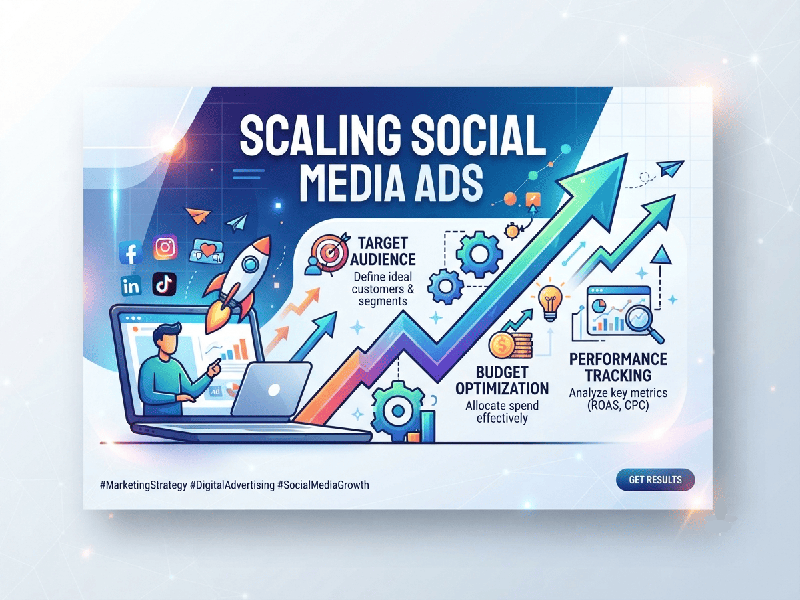
Scaling Social Media Ads
Scaling social media ads effectively is no longer
about micromanaging tiny audience interest groups or keyword combinations;
modern algorithms (such as Meta’s Advantage+ or TikTok’s recommendation engine)
have automated targeting.
Instead, scaling social media ads is primarily a
creative and structural challenge. If your creatives burn out or your
budget management triggers the algorithm's learning phase reset, your
cost-per-acquisition (CPA) will spike.
A practical, data-backed blueprint to scale paid
social ads efficiently includes the following steps:
1. Master
Creative-Led Scaling
Because algorithms handle delivery and audience
matching, your ad creative acts as your primary targeting tool. If you
want to scale spend, you must scale your creative production volume.
- Track Leading Indicators: Do not wait for Return on Ad
Spend (ROAS) to tell you an ad is failing. Monitor Hook Rate
(Thumb-Stop Rate)—the percentage of people who watch past the first 3
seconds (aim for >25–30%). If people aren't stopping to watch, the ad
cannot scale.
- Monitor Hold Rate: Measure how many viewers stay
through the 15-second mark (ThruPlays). A high hook rate with a low hold
rate means your ad is "clickbait," which wastes budget
downstream.
- Build a Creative Iteration
Pipeline: Do
not just build entirely new concepts; take your winning angles and iterate
on the hooks, the first 3 seconds, or the visual pacing.
2. Choose the Right Budget Scaling Method
Doubling or tripling a budget overnight forces
campaigns back into the "learning phase," instantly tanking
performance. Use these two proven scaling methods instead:
- Vertical Scaling (Gradual Budget
Bumps):
o Increase budgets by 15% to 25%
every 48 to 72 hours, but only if the campaign has maintained a
stable CPA and volume for at least 5 consecutive days.
- Horizontal Scaling (Duplication
& Diversification):
o Instead of forcing a single campaign
to absorb a massive budget increase, duplicate your winning ad sets or
campaigns at their original budgets.
o Broaden your structural footprint by
testing new creative angles, introducing new geographic regions, or moving to
broad/open targeting configurations.
3. Consolidate Campaign Structure
Avoid fragmenting your budget across dozens of
hyper-narrow ad sets. Modern machine learning thrives on data density.
- Consolidate into Broad Groups: Group your spending into fewer,
larger campaigns. Let the platform’s algorithm distribute budget
dynamically to the specific users and creatives driving conversions.
- Let the Data Accumulate: Aim for a minimum of 50
conversions per week per campaign structure to give the algorithm enough
signal data to optimize bidding accurately.
4. Combat Creative Fatigue Proactively
Creative fatigue happens faster the more you scale,
because you are exposing your ads to a larger percentage of the market at a
quicker rate.
- Watch Frequency Metrics: Keep an eye on frequency (how
many times on average a user sees your ad). When frequency climbs past
3.0+ alongside a declining Hook Rate, fatigue has set in.
- Maintain a Fresh Asset Queue: Always have a rotation of
backup creatives ready to deploy the moment a top-performing ad begins
showing signs of fatigue.