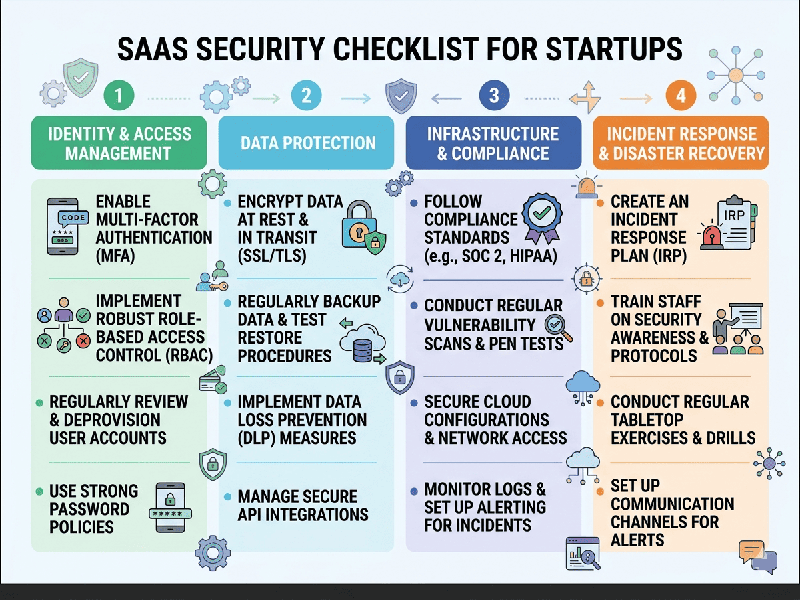
SaaS Security Checklist for Startups
When you are building a SaaS startup, security can't be an
afterthought. Retrofitting security architecture right before trying to close
an enterprise client can delay your market entry by 6 to 12 months.
To help you build a solid foundation from day one, here is a
practical, scannable security checklist broken down by domain.
1. Identity & Access Management (IAM)
- Enforce Multi-Factor
Authentication (MFA): Mandate MFA across all company tools (Google Workspace,
AWS/GCP/Azure consoles, Slack, etc.). This simple step stops roughly 99%
of automated account attacks.
- Implement a
"Joiner-Mover-Leaver" Process: Automate how permissions are granted when
someone joins, shifted when they change roles, and immediately revoked
the day they leave.
- Centralize with Single Sign-On
(SSO): Use a
primary Identity Provider (IdP) like Okta, Azure AD, or Google Workspace
to manage employee logins. This makes offboarding instant across all
integrated apps.
- Principle of Least Privilege: Employees and system services
should only have the exact access required to perform their daily duties.
No one should be running with root/admin privileges for standard tasks.
2. Data Protection & Cryptography
- Encrypt Data in Transit: Secure all web traffic, API
endpoints, and internal microservice communications using strong protocols
like HTTPS and TLS 1.3.
- Encrypt Data at Rest: Ensure all databases, cloud
storage buckets, and backups are encrypted using standard algorithms like AES-256.
- Secure Secrets Management: Never hard-code API keys,
database credentials, or secret tokens into your repository code. Use
tools like HashiCorp Vault, AWS Secrets Manager, or GitHub Secrets with
automated rotation policies.
- Multi-Tenancy Isolation: If you store data from multiple
clients on shared infrastructure, establish logical and cryptographic
separation to prove customer data cannot leak into another customer's
environment.
3. Application & Product Security
- Defend Against the OWASP Top 10: Build code explicitly designed
to mitigate common vulnerabilities like SQL Injection, Cross-Site
Scripting (XSS), and Broken Access Control.
- Automate Dependency Scanning: Integrate Software Composition
Analysis (SCA) tools into your CI/CD pipeline to automatically scan for
vulnerable third-party open-source libraries before code hits production.
- Secure the API Gateway: Limit rate inputs (Rate
Limiting) to prevent Denial of Service (DoS) attacks and ensure all
exposed APIs require strong authorization tokens.
- Third-Party Penetration Testing: Schedule an independent,
adversarial penetration test by an external firm at least once a year.
Automated vulnerability scans are helpful, but B2B buyers want to see a
certified pen-test report.
4. Cloud Infrastructure & Operations
- Infrastructure as Code (IaC): Manage your infrastructure
configurations via version-controlled code (e.g., Terraform). This
eliminates manual configuration drift and tribal knowledge.
- Network Segmentation: Use Virtual Private Clouds
(VPCs) and distinct subnets to isolate your public-facing web servers from
your private database clusters.
- Centralized Auditing &
Logging:
Collect and monitor system logs, authentication events, data exports, and
administrative actions. Ensure these logs are immutable (cannot be altered
or deleted).
5. Resilience & Business Continuity
- The 3-2-1 Backup Rule: Maintain at least 3 copies
of your data, stored on 2 different mediums, with at least 1
copy stored offsite (in a separate cloud region or entirely isolated
infrastructure).
- Formal Incident Response Plan: Write down exactly who needs to
be notified, how to isolate a compromised system, and how to preserve
evidence if a breach occurs. Run a mock drill annually.