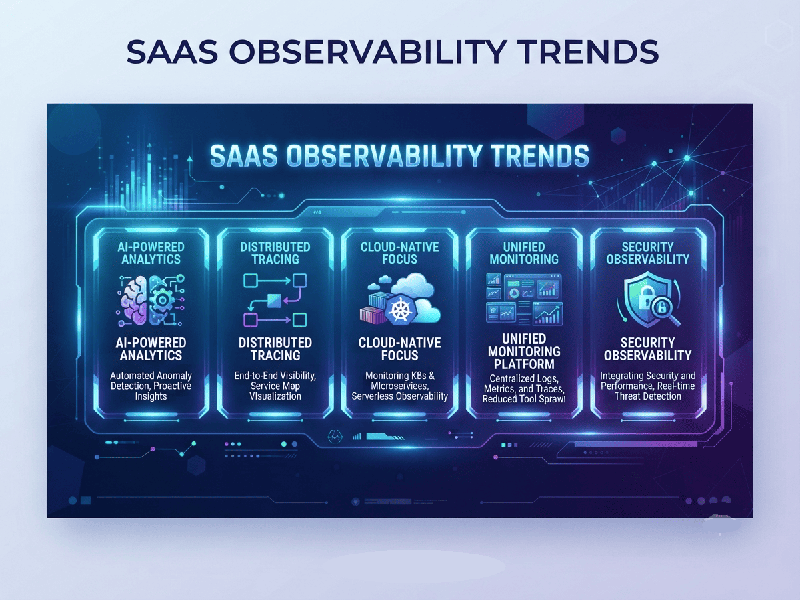
SaaS Observability Trends
The SaaS observability landscape has shifted from
basic system monitoring to a strategic business function. The focus is no
longer just on "collecting everything," but on intelligent,
automated, and business-aligned visibility.
1. The Rise of Agentic & Intelligent Observability
As SaaS architectures grow more complex, human-speed
operations are no longer sufficient.
- Agentic AI Integration: Observability platforms are
integrating AI agents that don't just alert, but actively
"reason" about data. These agents can perform root cause
analysis, reroute traffic, restart services, or roll back deployments
autonomously, provided they operate within human-defined guardrails.
- AI as a Collaborator: AI has evolved from simple
copilots to active collaborators that correlate disparate logs, metrics,
and traces across the entire stack, significantly reducing the "mean
time to repair" (MTTR).
2. Shift to "Value-Based" Observability
The "collect and keep everything" mindset is
becoming financially unsustainable due to exploding telemetry volumes.
- Adaptive Telemetry: Organizations are adopting
intelligent filtering to keep only high-value data, often reducing storage
requirements by 50%–80% without losing critical insights.
- Data Tiering: To control costs, teams are
routing critical real-time data to high-performance platforms while moving
historical or long-tail data to lower-cost storage like object storage or
security data lakes.
- Focus on Business Impact: Leaders are now demanding that
observability be tied to business KPIs (e.g., revenue impact, customer
churn, or marketing conversion rates) rather than just technical uptime
metrics.
3. Open Standards as the Default
- OpenTelemetry (OTel) Dominance: OTel has become the industry
standard for telemetry collection. In 2026, the question is no longer
whether to use it, but how to optimize its implementation across the
enterprise.
- Unified Observability: The "single pane of
glass" model is becoming the default, not necessarily through a
single massive tool, but through platforms that align diverse teams
(DevOps, SRE, Security, and Product) around shared data and outcomes.
4. AI Observability (Observing the AI Itself)
As SaaS platforms bake AI into their products, they
must now observe the AI pipelines themselves.
- New Metrics: Observability now includes
monitoring AI-specific health indicators like token costs, model
drift, accuracy decay, hallucination rates, and ethical
guardrails.
Full Lifecycle Monitoring: AI monitoring is embedded across the entire lifecycle—from training and inference to feedback loops—ensuring that LLMs and other AI components remain reliable and cost-effective.