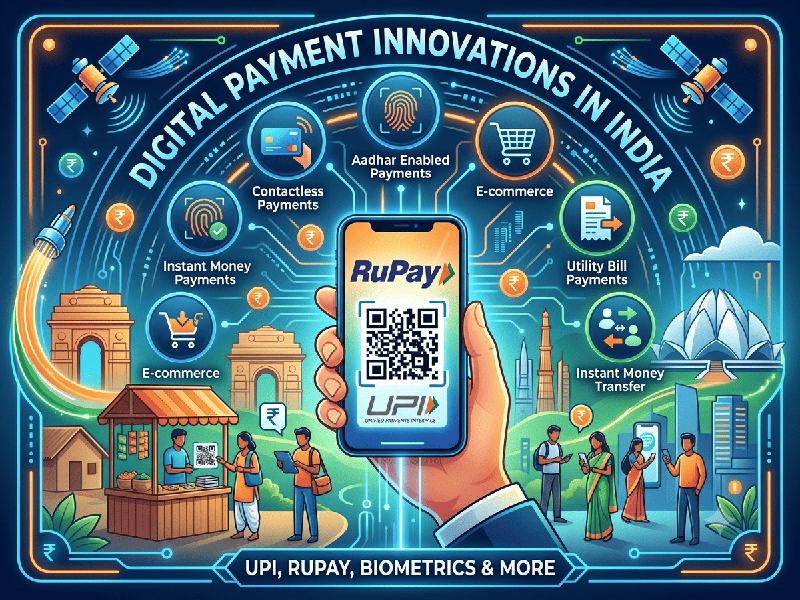
Digital Payment Innovations in India
The digital payments landscape in India as of 2026 is
defined by unprecedented scale, the maturation of foundational systems like
UPI, and a strategic pivot toward embedded finance, AI-driven security, and
advanced merchant tools.
1. The Dominance and Evolution of UPI
UPI remains the backbone of the Indian digital
economy, with transaction volumes consistently reaching tens of billions per
month.
- Expansion of Scope: Beyond simple peer-to-peer
transfers, UPI is being integrated into global corridors, allowing for
seamless use in international markets.
- UPI Lite: Designed to handle small-value,
high-frequency transactions, reducing the load on core banking systems
while offering instant, friction-free payments for everyday needs.
- Credit-on-UPI: This innovation allows users to
link credit instruments directly to the UPI interface, enhancing spending
power without requiring traditional physical card infrastructure at the
point of sale.
2. Merchant-Centric Innovations
The focus has shifted from mere adoption to deepening
the merchant ecosystem.
- SoftPOS: Merchants are increasingly
using smartphones as Point-of-Sale (POS) terminals. By turning any
NFC-enabled device into a payment receiver, small businesses can accept
cards, wallets, and UPI payments without expensive hardware.
- QR Code Proliferation: Universal QR codes have become
the standard for offline retail, effectively digitizing the
"mom-and-pop" store experience even in Tier 3–6 cities.
- Embedded Finance: Digital payments are now deeply
embedded into non-financial apps. Merchants are gaining access to credit
and analytics based on their digital transaction trails, turning payment
acceptance into a growth engine for their businesses.
3. Emerging Technologies and Infrastructure
- AI-Driven Fraud Detection: With the rise in digital
volume, cybersecurity has moved to the frontline. Banks and payment
aggregators now use real-time AI and machine learning models to detect
suspicious patterns and mule accounts, shifting from rule-based systems to
adaptive, behavior-based security.
- Central Bank Digital Currency
(e₹): The
Digital Rupee (e₹) pilot has matured, offering a digital form of physical
cash that is issued by the RBI. It provides a secure, programmable, and
always-on alternative for both retail and wholesale segments.
- Tokenisation: Mandatory tokenisation for
card-on-file transactions has become a standard, replacing raw card
details with secure tokens to enhance trust and reduce fraud in both
ecommerce and physical tap-and-pay scenarios.
4. Convergence of Identity and Payments
A major trend in 2026 is the "Log in and
Pay" model. Digital identity wallets are being used to link verified
authentication with payment authorization in a single action, drastically
reducing friction while strengthening security through government-verified
credentials.