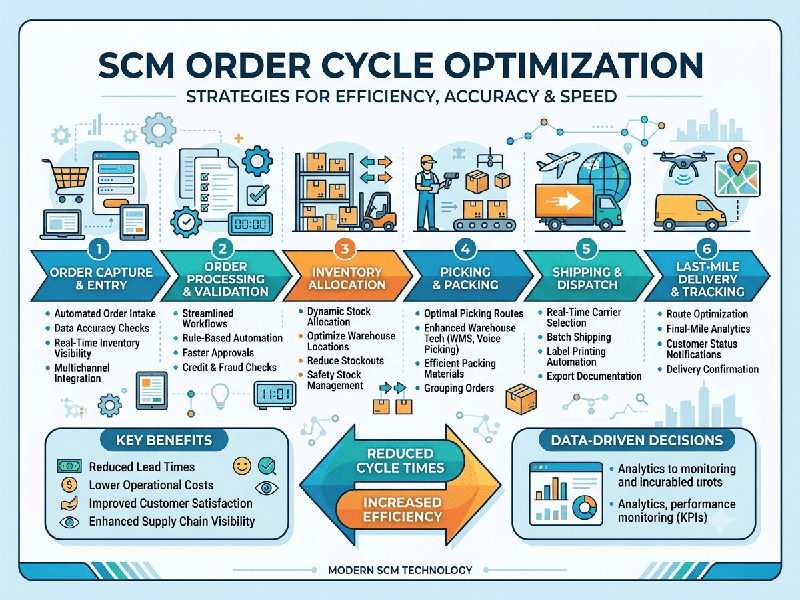
SCM Order Cycle Optimization
Supply Chain Management (SCM) Order Cycle Optimization involves streamlining, automating,
and accelerating every step required to turn a customer order into a delivered
product.
The Order Cycle Time (OCT)—also called Order
Lead Time—is the total elapsed time from the moment a customer places an
order to the point they physically receive the goods. Shortening and
stabilizing this cycle directly improves cash flow, lowers operational costs,
and boosts customer satisfaction.
1. Key Stages of the Order Cycle
To optimize the cycle, each of its core stages must be
evaluated and streamlined:
1.
Order Placement & Entry: Receipt of the purchase order via e-commerce, EDI
(Electronic Data Interchange), or sales channels.
2.
Order Processing & Verification: Credit check, stock availability validation, and
payment processing.
3.
Fulfillment & Warehousing: Order picking, packing, kitting, and labeling in the
warehouse or distribution center.
4.
Outbound Logistics & Dispatch: Carrier assignment, route optimization, loading, and
transit.
5.
Final Delivery & Proof of Delivery (PoD): Last-mile transportation, doorstep
delivery, and digital receipt confirmation.
2. Core Optimization Strategies
A. Order Entry & Inventory Visibility Automation
- Unified OMS/ERP Systems: Replace manual data entry with
integrated Order Management Systems (OMS) connected to Enterprise
Resource Planning (ERP) software to auto-validate orders instantly.
- Real-Time Distributed Inventory: Provide immediate, accurate
visibility across warehouses, stores, and fulfillment centers to avoid
backorders or processing delays.
B. Warehouse Management & Automation (WMS)
- Dynamic Wave & Batch
Picking: Use a Warehouse
Management System (WMS) to cluster orders intelligently, minimizing
worker travel time inside the warehouse.
- Goods-to-Person (G2P)
Technologies:
Deploy automated guided vehicles (AGVs), Autonomous Mobile Robots (AMRs),
or conveyor systems to speed up the pick-and-pack workflow.
C. Smart Logistics & Last-Mile Delivery
- Automated Carrier Selection: Leverage Transportation
Management Systems (TMS) to automatically select the optimal carrier based
on cost, transit time, and reliability metrics.
- Dynamic Route Optimization: Utilize AI-driven routing
engines to factor in real-time traffic, weather, and delivery windows,
cutting transit times and fuel expenses.
D. Predictive Analytics & Demand Forecasting
- Pre-positioning Inventory: Use machine learning to
forecast demand localized down to specific regions, placing high-velocity
SKUs closer to end customers (micro-fulfillment).