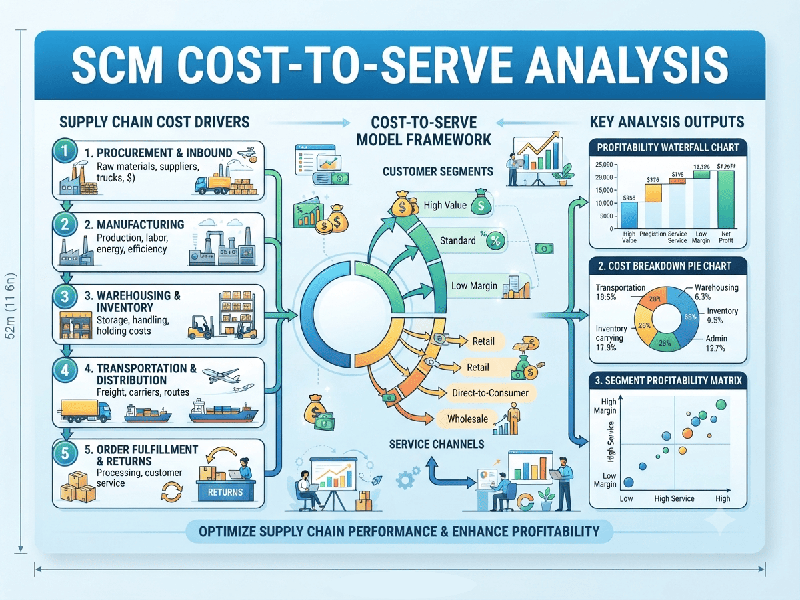
SCM Cost-to-Serve Analysis
A Cost-to-Serve (CTS) analysis is an advanced
supply chain framework used to calculate the exact, granular cost of fulfilling
specific products, orders, channels, or customers. While traditional accounting
looks at high-level profit and loss (P&L) statements, a CTS analysis uncovers
hidden operational expenses, revealing that gross margins on paper often differ
drastically from actual bottom-line profitability.
1. Cost Categories in a CTS Model
A comprehensive CTS framework breaks down expenses
into direct and indirect layers across the end-to-end supply chain:
- Procurement & Production
Costs: Raw
materials, manufacturing overhead, and inbound freight.
- Warehousing & Handling
Costs:
Inventory carrying costs, storage, labor for picking, packing, and
internal processing.
- Transportation & Logistics
Costs: Outbound
freight, last-mile delivery, fuel surcharges, multi-stop fees, and
expedited or rush shipping.
- Customer-Specific &
Servicing Costs:
Order processing overhead, customer service interactions, returns
processing (reverse logistics), custom packaging, and extended payment
terms.
2. Step-by-Step Implementation Framework
- Step 1: Map the Activity-Based
Costs (ABC):
Instead of broad cost allocations, use Activity-Based
Costing to trace resources to activities (e.g., picking a single item vs. a
full pallet) and then to specific cost objects like customers or SKUs.
- Step 2: Identify Key Cost
Drivers:
Pinpoint variables that trigger expenses. Common
drivers include:
o Order frequency and size (e.g.,
frequent small orders vs. bulk seasonal orders).
o Product complexity and return rates.
o Special handling or customized
service level agreements (SLAs).
- Step 3: Segment Customers and
Products:
Group your portfolio to evaluate performance
matrices—identifying which high-revenue clients or product lines actually drain
resources due to high serving complexity.
- Step 4: Compare Against Revenue
and Margin:
Calculate true net profitability by subtracting the
total cost-to-serve from the gross revenue for every customer or product
segment.
3. Strategic Applications & Business Value
- Optimize Pricing &
Commercial Terms: Equip sales and finance teams to negotiate contracts that account
for high-touch service requirements, or implement Minimum Order Quantities
(MOQs) to curb unprofitable small orders.
- Rationalize Product Portfolios: Identify
"margin-diluting" SKUs that require intensive handling relative
to their sales volume, enabling targeted discontinuation or price
adjustments.
- Refine Customer Segmentation: Shift low-margin,
high-maintenance accounts toward automated self-service portals, or adjust
pricing tiers to match the actual cost of delivery.