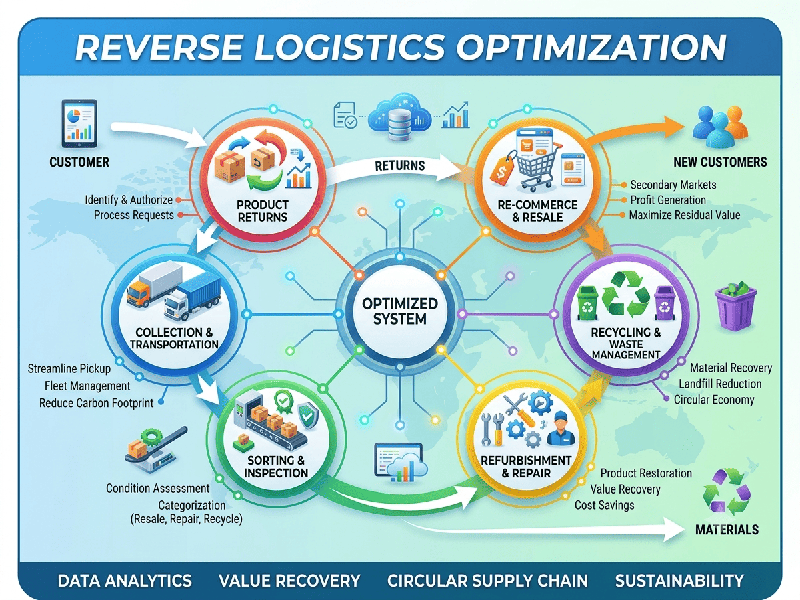
Reverse Logistics Optimization
Reverse Logistics refers to the process of moving goods from their
typical final destination (the customer) back to the seller or manufacturer. In
a modern supply chain, this isn't just about "returns"; it is a
value-recovery process involving repairs, recycling, refurbishing, or
restocking.
Reverse Logistics Optimization is the practice of making this flow
as cost-effective, sustainable, and customer-friendly as possible.
The 5 Key Pillars of Optimization
To optimize reverse logistics, you must treat the
return journey with the same level of analytical rigor as the forward supply
chain.
1. Smart Triage and Dispositioning
Not every returned item belongs in the same place.
Optimization begins by deciding the item's "disposition" as early as
possible.
- The Goal: Minimize "touch
points."
- Strategy: Use AI-driven grading at the
point of return. If a product is unopened, route it back to the warehouse
for restocking. If it is damaged, route it directly to a repair facility
or a recycling center, bypassing the main distribution hub entirely.
2. Centralized Return Centers (CRC)
Many companies make the mistake of funneling all
returns back into their main forward-logistics warehouses.
- The Strategy: Establish dedicated Centralized
Return Centers designed specifically for processing, inspecting, and
re-packaging. These centers are optimized for speed and labor efficiency,
which differs significantly from the "pick-and-pack" workflows
of forward warehouses.
3. Data-Driven Visibility
You cannot optimize what you cannot track.
- The Strategy: Implement a Return Management
System (RMS). This provides real-time visibility into the
"in-transit" state of returned goods. Knowing an item is coming
back before it arrives allows you to adjust inventory levels and
plan labor at the warehouse accordingly.
4. "Keep it" Policies (Financial
Optimization)
Sometimes, the cost of the logistics (shipping +
processing) exceeds the value of the recovered item.
- The Strategy: Use predictive analytics to
determine the "break-even" point. For low-value,
high-shipping-cost items, it is often more profitable to issue a refund
and tell the customer to keep, donate, or recycle the item, thereby saving
on reverse freight costs.
5. Circular Supply Chain Integration
Optimization goes beyond just "saving
money"—it's about sustainability and value recovery.
- The Strategy: Re-integrate returned
components back into the production line. This reduces the need for raw
materials and lowers the total cost of ownership.