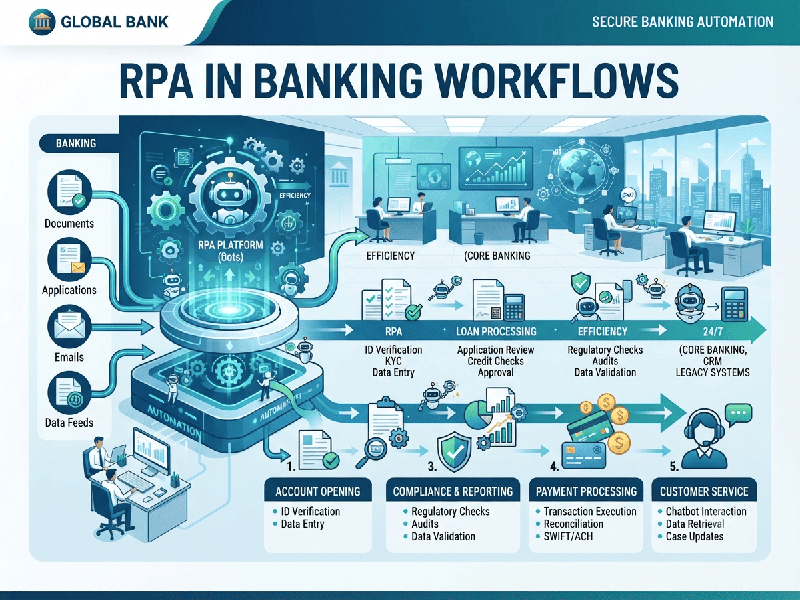
RPA in Banking Workflows
Robotic Process Automation (RPA) in banking refers to
the use of "software bots"—digital workers that mimic human
actions—to execute repetitive, rule-based tasks across banking systems. By
automating these processes, banks can significantly reduce manual effort,
minimize human error, and accelerate turnaround times for both front-office and
back-office operations.
Key Use Cases in Banking
RPA is widely used to handle high-volume, data-heavy
workflows:
- Customer Onboarding & KYC: RPA bots automatically collect,
validate, and verify customer documents against internal and external
databases, drastically reducing the time required to open new accounts.
- Loan & Mortgage Processing: Bots streamline underwriting by
pulling credit reports, verifying employment history, and checking
eligibility criteria, often shortening approval times from days to hours.
- Fraud Detection: By monitoring transactions in
real-time, RPA can trigger alerts or block suspicious activity
immediately, providing a faster response than manual oversight.
- Accounts Payable/Receivable: Bots extract invoice data using
OCR (Optical Character Recognition), validate amounts against purchase
orders, and process payments without manual data entry.
- Regulatory Reporting: RPA ensures compliance by
automating the generation of mandatory reports, maintaining detailed audit
trails for regulators, and tracking policy changes.
- Account Maintenance: Tasks such as closing inactive
accounts, updating customer information, or handling fee-related inquiries
are automated to ensure consistency.
Primary Benefits for Financial Institutions
- Operational Efficiency: Eliminates the "manual
bottleneck," allowing staff to shift focus from data entry to
higher-value activities like relationship management and complex
problem-solving.
- Cost Reduction: Automating routine tasks
typically reduces operational costs by 25–50% by lowering manual labor
requirements and reducing the financial impact of errors.
- Improved Accuracy: Since bots follow rigid rules,
the risk of data entry errors is near-zero, ensuring that financial
reporting and customer records remain consistent.
- Enhanced Compliance: Automated processes generate
100% accurate, timestamped audit logs, simplifying the process of meeting
stringent banking regulations.
- Scalability: Bots can operate 24/7 and can
easily handle spikes in transaction volume without the need to hire or
train temporary staff.
How it Integrates
Banking automation typically involves a layered
approach where RPA serves as the "execution arm." It is often
combined with other technologies to handle more complex scenarios:
- RPA + AI/ML: Used for intelligent
decision-making, such as identifying patterns in fraud that rules-based
systems might miss.
- RPA + OCR/IDP: Used for "Intelligent
Document Processing," allowing bots to "read" and extract
information from unstructured documents like PDF statements or physical
forms.
- RPA + APIs: Enables seamless communication
between disparate, older legacy systems and modern cloud-based banking
applications.