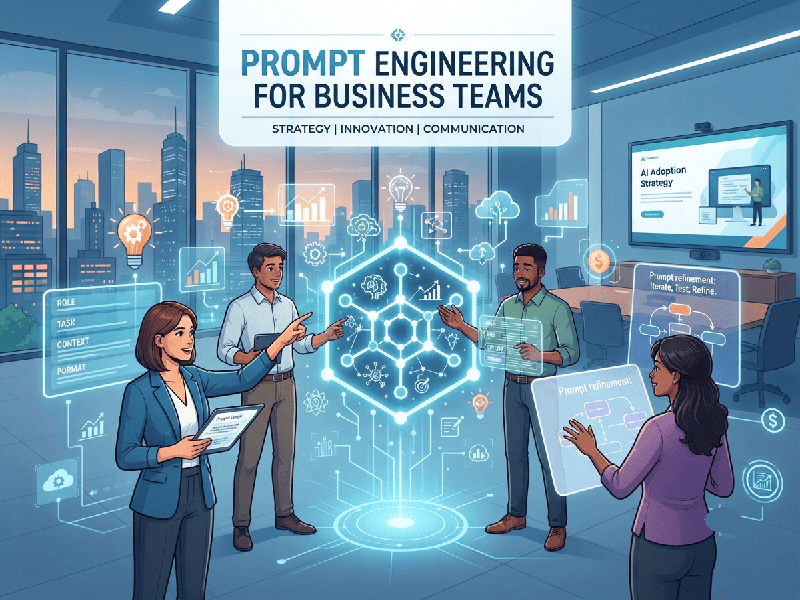
Prompt Engineering for Business Teams
Prompt Engineering for Business Teams is the practice of structuring
instructions, context, and constraints so that generative AI models produce
dependable, accurate, and brand-aligned results.
In a business context, prompt engineering moves away
from casual, trial-and-error questioning and treats prompts as reusable
operational assets—similar to templates, standard operating procedures
(SOPs), or mini-processes.
1. The Core Anatomy of a Business Prompt
To get consistent results across different team
members, a strong business prompt should follow a structured framework (often
abbreviated as R-TCC-O: Role, Task, Context, Constraints, Output):
- Role: Define who the AI is simulating
(e.g., "Act as an experienced HR business partner" or "Senior
Financial Analyst").
- Task: State the exact action verb and
desired outcome clearly (e.g., "Analyze month-end budget variances
and explain primary drivers").
- Context: Provide background data, target
audience, or the purpose of the work (e.g., "The audience is the
Finance Director; focus on operational risks").
- Constraints: Set boundaries to ensure
compliance and accuracy (e.g., "Use only the attached P&L
sheet. Do not make external assumptions. Exclude PII").
- Output Format: Specify how you want the
results structured (e.g., "Present findings in a markdown table
followed by a 150-word executive summary").
3. Departmental Use Cases
- Marketing & Communications: Moving beyond generic idea
generation by injecting brand voice, channel constraints, and audience
parameters into prompts to scale content creation (blogs, email sequences,
social copy).
- Customer Support: Standardizing response tone,
empathy levels, and escalation steps to ensure consistent customer
interactions across support tiers.
- Finance & Operations: Analyzing uploaded data sets
(CSV/PDF financial statements), checking line-item variances, and
structuring operational reports.
- Human Resources & Legal: Normalizing job descriptions,
drafting initial policy overviews, or screening text against compliance
guidelines while stripping out personally identifiable information (PII).
4. Best Practices for Scaling Across an Organization
1.
Build a Prompt Library: Store high-performing, tested prompts in a shared company
repository (like Notion or an internal wiki) so teams don't have to reinvent
the wheel.
2.
Establish Quality Rubrics: Evaluate outputs based on a shared standard (e.g., scoring factual
accuracy, relevance, brevity, and safety out of 10).
3. Mitigate Hallucinations: Always ground prompts in trusted enterprise data (by uploading source files or linking internal documentation) and explicitly instruct the model: "If the answer cannot be found in the provided text, state 'I don't know' rather than guessing."