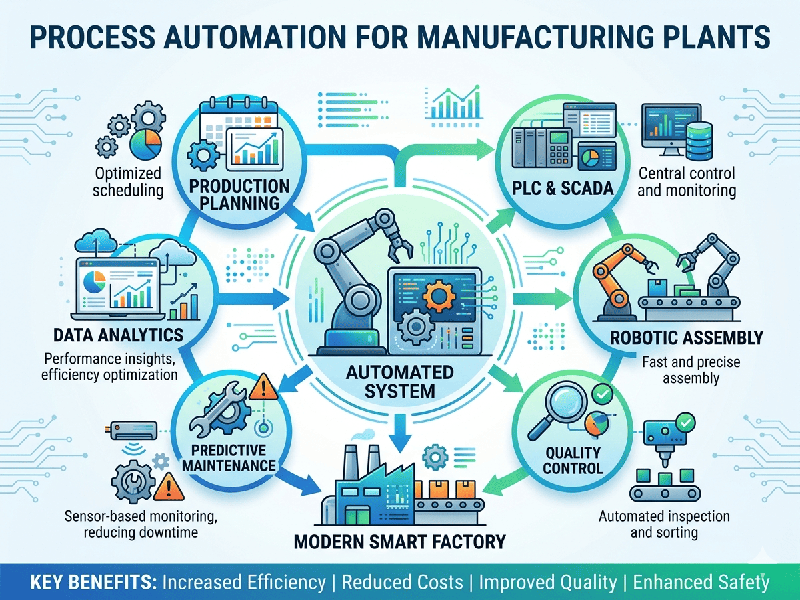
Process Automation for Manufacturing Plants
Process automation in manufacturing has transitioned from
simple robotics to Hyper-automation and Industry 5.0. The focus
is no longer just on replacing manual labor, but on creating a
"closed-loop" ecosystem where AI, humans, and machines collaborate to
optimize every second of production.
1. Hyper-Automation & AI-Driven Intelligence
Automation is moving beyond individual tasks to orchestrating
entire production lines.
- Self-Optimizing Lines: AI models analyze throughput in
real-time, adjusting machine speeds and temperatures to eliminate
bottlenecks without human intervention.
- Predictive Maintenance 2.0: Using deep learning, machines
now monitor their own vibrations and thermal signatures to predict
failures weeks in advance, reducing unplanned downtime by up to 50%.
- Digital Twins: Every physical asset has a
virtual counterpart. Engineers run "what-if" simulations on the
digital twin to test new workflows before implementing them on the shop
floor.
2. Collaborative Robotics (Cobots) & AMRs
The "caged" industrial robot is being replaced by
flexible, mobile systems that share the workspace with humans.
- Cobots: These robots handle repetitive,
ergonomically taxing tasks (like heavy lifting or precision soldering)
while working safely alongside operators. They use advanced vision sensors
to "see" and avoid humans.
- Autonomous Mobile Robots (AMRs): Unlike traditional AGVs that
require fixed floor tracks, 2026 AMRs use LiDAR and SLAM (Simultaneous
Localization and Mapping) to navigate dynamic plant floors, delivering
materials just-in-time to different stations.
3. Industrial IoT (IIoT) & Edge Computing
To manage the massive data generated by thousands of sensors,
plants are shifting from pure cloud processing to Edge Computing.
- Low-Latency Control: Critical decisions (like
emergency shutdowns or quality rejects) happen at the "Edge" (on
the machine itself) to avoid the delay of sending data to a remote server.
- Unified OT/IT: Shop-floor data (Operational
Technology) is now seamlessly integrated with enterprise systems
(Information Technology like ERP and CRM), allowing production schedules
to update automatically based on real-time sales orders.
4. Vision-Based Quality Control
Human inspection is being replaced by high-speed AI vision
systems.
- Micro-Defect Detection: Cameras with sub-millimeter
precision scan products at full production speed, identifying cracks or
misalignments invisible to the human eye.
- Automated Sorting: AI classifies defects by type
and severity, automatically routing "reworkable" items back into
the loop and discarding "scrap" to minimize waste.