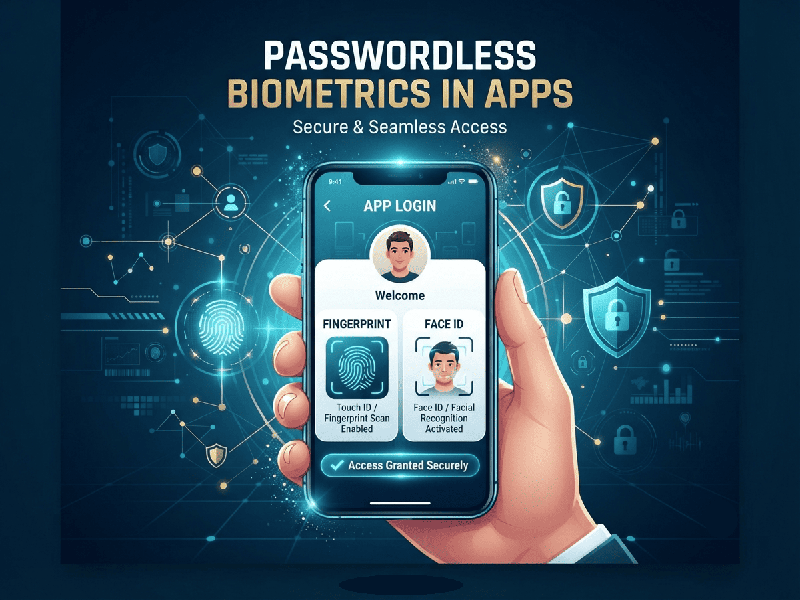
Passwordless Biometrics in Apps
Passwordless biometrics refers to authenticating users
in mobile and web applications using unique biological or physical
characteristics—such as fingerprints, facial recognition, or iris scans—instead
of traditional alphanumeric passwords.
This approach relies on FIDO (Fast Identity Online)
standards and Passkeys, replacing shared secrets (passwords stored on
servers) with secure cryptographic key pairs.
How It Works
1.
Registration (Enrollment):
o When a user opts for biometric login
on their device, a unique public/private cryptographic key pair is generated.
o The private key is securely
stored in the hardware-backed secure enclave/element of the user's device
(never leaving it).
o The public key is registered
with the app's server.
2.
Authentication:
o When logging in, the app prompts the
user for biometric verification (e.g., Face ID or Touch ID).
o Upon successful local biometric
match, the device unlocks the private key to digitally sign a challenge sent by
the server.
o The server verifies the signature
using the public key, granting instant access without ever processing or
storing raw biometric data or passwords.
Key Benefits
- Enhanced Security: Eliminates vulnerabilities tied
to credential stuffing, brute-force attacks, and weak/reused passwords.
Because raw biometric data or private keys never leave the local device,
remote server breaches don't expose user credentials.
- Phishing Resistance: Cryptographic bindings ensure
that a passkey or biometric challenge only responds to the exact domain or
application it was registered for, making traditional phishing sites
ineffective.
- Superior User Experience: Users no longer need to
memorize, regularly update, or type complex passwords. Logins happen
seamlessly in fractions of a second.
- Reduced Operational Costs: Drastically cuts down help desk
support tickets and resources spent on password reset workflows.
Implementation Considerations
- Fallback Mechanisms: Apps must provide alternative
recovery methods (such as hardware tokens, secure OTPs, or verified
recovery flows) in case a user changes devices, experiences hardware
failure, or has a temporary physical injury impacting biometric reads.
- Privacy & Compliance: While biometrics stay local to
the device and protect user privacy, apps must adhere strictly to data
regulations (like GDPR or CCPA) regarding how metadata or user sessions
are managed