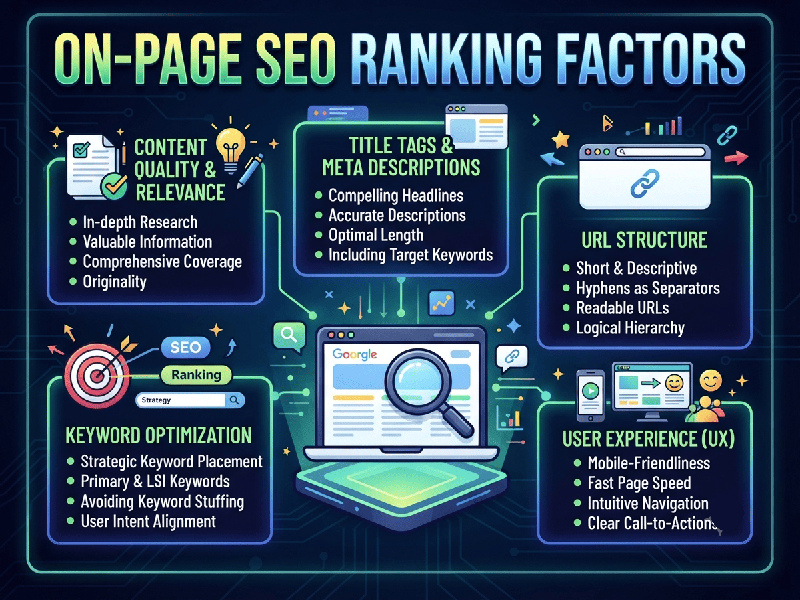
On-Page SEO Ranking Factors
On-page SEO has shifted from "keyword
optimization" to intent satisfaction and user experience. Google’s
AI-driven systems prioritize content that is helpful, trustworthy, and easy for
both users and machines to interpret.
1. The Core Pillars of On-Page SEO
- Search Intent Alignment: The single most important
factor. Your content must directly solve the user's problem. Google
evaluates if a user’s search is satisfied in one visit or if they return
to search results (a "bounce").
- E-E-A-T (Experience, Expertise,
Authoritativeness, Trustworthiness): Demonstrate first-hand experience (e.g., case
studies, original research). Use clear author bios, cite reputable
sources, and ensure your brand identity is consistent across the web.
- Topical Authority: Rather than targeting isolated
keywords, build "content clusters" (Hub & Spoke model). A
hub page targets a broad topic, while "spoke" pages cover
specific sub-topics, all interlinking to establish deep niche expertise.
2. Essential Technical & Structural Elements
- Page Experience (Core Web
Vitals): These
are non-negotiable performance metrics.
o LCP (Largest Contentful Paint): Loading speed (aim for < 2.5s).
o INP (Interaction to Next Paint): Responsiveness to user input (aim
for < 200ms).
o CLS (Cumulative Layout Shift): Visual stability during loading (aim
for < 0.1).
- Internal Linking: A strategic way to pass
authority between pages. Use descriptive, relevant anchor text to help
Google understand your site’s hierarchy.
- Structured Data (Schema): Use JSON-LD to help AI systems
interpret your content (e.g., FAQ, HowTo, Product, or Organization
schema).
4. AI-Friendly Optimization
With the rise of AI Overviews and SGE (Search
Generative Experience), structure your content to be "extractable":
- Direct Answers: Place concise, direct answers
to the query at the beginning of your content.
- Semantic Formatting: Use tables for comparative data
and clear, question-based headings.
- Verification: Ensure your content is easy for
AI to cite by providing transparent data, clear logic, and credible
sources.