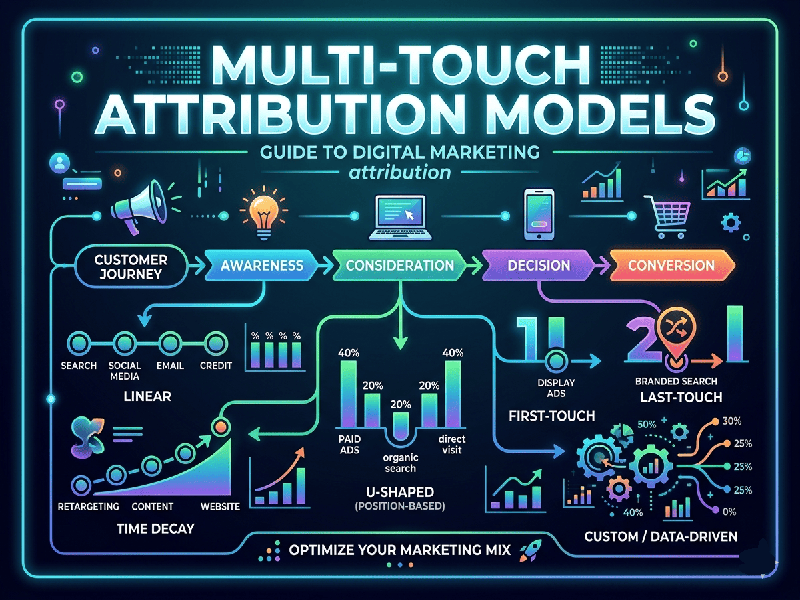
Multi-Touch Attribution Models in Digital Marketing
Multi-Touch Attribution (MTA) has shifted from simple
rule-based logic to AI-driven algorithmic modeling. As privacy
regulations (like the deprecation of third-party cookies) have made tracking
more difficult, MTA now relies on unified data streams to credit various
touchpoints in a customer's journey.
1. Traditional Rule-Based Models
These models follow pre-defined logic to distribute credit.
While less sophisticated, they provide a clear, consistent baseline for
performance.
- Linear Attribution: Every touchpoint gets equal
credit. If a customer clicks an ad, a social post, and an email before
buying, each gets 33.3%.
o Best for: Long sales cycles where maintaining
brand awareness is as important as the final sale.
- Time Decay: Touchpoints closer to the time
of conversion get more credit. An ad clicked an hour before purchase gets
significantly more weight than a search performed two weeks ago.
o Best for: Short-cycle promotional campaigns.
- U-Shaped (Position-Based): 40% credit goes to the first
touch, 40% to the last touch, and the remaining 20% is distributed among
the middle interactions.
o Best for: Understanding what starts the
journey and what closes the deal.
2. Advanced Algorithmic & Data-Driven Models
These are the gold standard. They use machine
learning to calculate the actual "lift" each channel provides.
- Data-Driven Attribution (DDA): Instead of a fixed rule, AI
analyzes your historical data to see which touchpoints actually increase
the probability of conversion. If removing "Video Ads" from a
journey consistently leads to a 20% drop in sales, the model assigns
higher value to those ads.
- W-Shaped Attribution: An evolution of the U-shaped
model. It gives 30% credit to the First Touch, Lead Creation,
and Opportunity Creation, with 10% spread across the remaining
"filler" touchpoints.
o Best for: B2B marketing where the journey
moves through distinct lifecycle stages.
3. The 2026 Shift: Incrementality & MMM
Because tracking users across devices is increasingly
restricted, marketers are moving toward hybrid approaches.
- Incrementality Testing: This involves "ghost
bidding" or holdout groups to measure what would have happened if an
ad wasn't shown. This helps prove if a channel is truly driving new
growth or just taking credit for a user who was going to buy anyway.
- Marketing Mix Modeling (MMM)
Integration:
Large-scale brands now combine MTA (user-level data) with MMM (macro-level
statistical data) to account for offline influences like TV, radio, or
physical storefronts that digital-only MTA misses.