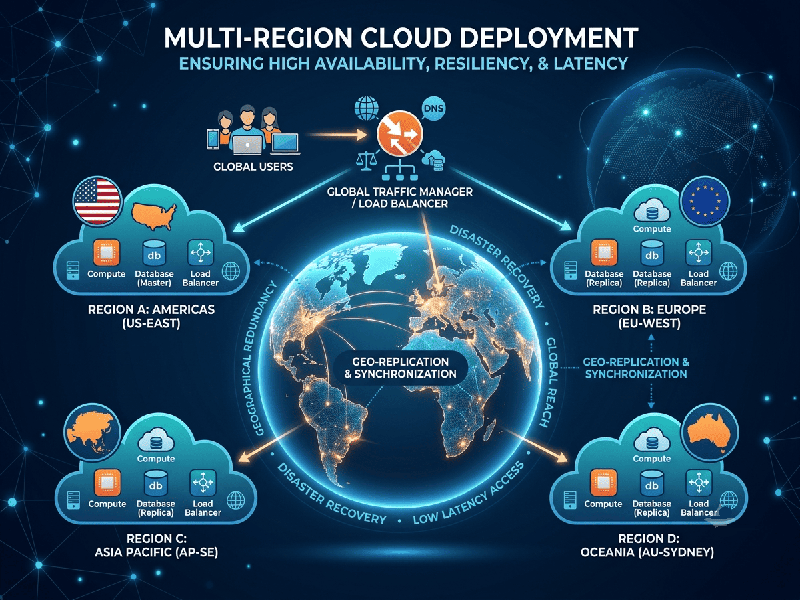
Multi-Region Cloud Deployment
Multi-Region Cloud Deployment is an architectural strategy where
applications, databases, and infrastructure are deployed across two or more
geographically distinct data center locations (regions) within a cloud provider
(such as AWS, Azure, or Google Cloud).
Core Architecture Models
- Active-Passive (Disaster
Recovery): The
primary region handles 100% of live traffic. Data is asynchronously or
synchronously replicated to a standby secondary region, which takes over
only if the primary region fails.
- Active-Active (High
Availability):
Application instances in multiple regions actively serve user traffic
simultaneously. Global load balancers direct users to the nearest healthy
region.
- Multi-Cloud Multi-Region: Infrastructure spans across
multiple cloud providers (e.g., AWS and Azure) across distinct
geographical zones to avoid vendor lock-in and vendor-specific region
outages.
Key Benefits
- Disaster Recovery & High
Availability: Protects
against major infrastructure failures, regional power grid issues, or
natural disasters that take down an entire cloud region.
- Ultra-Low Latency: Positions application instances
closer to global end-users, speeding up response times and edge rendering.
- Regulatory & Data
Sovereignty Compliance: Satisfies strict local privacy laws (e.g., GDPR) by
retaining and processing user data within specific geopolitical borders.
Architecture & Engineering Considerations
- Data Synchronization: Requires specialized
distributed databases (e.g., CockroachDB, AWS Aurora Global Database,
Spanner) to manage global data consistency, conflict resolution, and
cross-region replication latency.
- Global Traffic Routing: Relies on Anycast IPs or
latency-based DNS routing (e.g., AWS Route 53, Cloudflare, Azure Traffic
Manager) for automatic failover.
- Network & Transfer Costs: Ingress and egress network
charges increase significantly due to continuous cross-region data
replication.