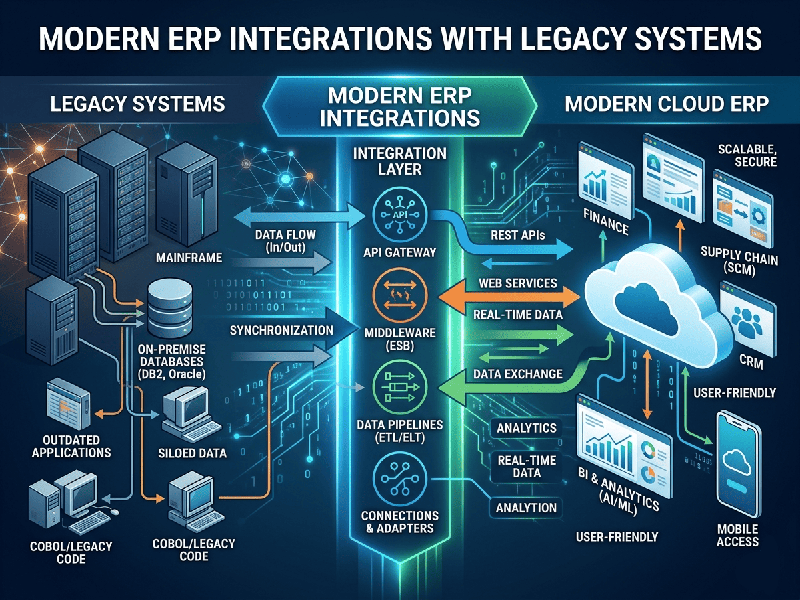
Modern ERP Integrations with Legacy Systems
The challenge is no longer just "connecting"
systems; it is bridging the gap between the speed of Cloud-Native ERPs
and the stability of decades-old Legacy Core Systems. The goal is to
move away from fragile, point-to-point connections toward a flexible,
event-driven architecture.
1. The "Sidecar" API Facade
Legacy systems often lack modern REST or GraphQL APIs. The
Facade pattern places a modern interface layer in front of the legacy system.
- Encapsulation: The legacy system remains
untouched. The "Facade" translates modern API calls (JSON/REST)
into the legacy system’s native language (SOAP, XML, or even direct
database queries).
- Security Injection: The facade can add modern
security features like OAuth2 or OpenID Connect to a system that
originally only supported simple passwords.
2. Event-Driven Architecture (EDA) & Change Data Capture
Modern ERPs thrive on real-time data, but legacy systems
often process in "batches." Change Data Capture (CDC) solves
this.
- Real-Time Sync: CDC tools (like Debezium) watch
the legacy database's transaction logs. When a row changes, it instantly
publishes an event to a message broker like Kafka or RabbitMQ.
- Loose Coupling: The modern ERP
"subscribes" to these events. This prevents the ERP from
overwhelming the legacy system with constant API requests.
3. Robotic Process Automation (RPA) as a "Last
Resort" API
When a legacy system has no database access and no API, RPA
acts as a bridge by mimicking human interaction.
- UI-Based Integration: "Bots" log into the
legacy green-screen or desktop interface, extract data, and push it into
the modern ERP via its API.
- Automated Data Entry: Useful for legacy systems where
the business logic is buried in the UI and cannot be bypassed.
4. Middleware & iPaaS (Integration Platform as a Service)
In 2026, many organizations use an iPaaS (like
MuleSoft, Workato, or Boomi) to act as the "universal translator."
- Pre-built Connectors: These platforms offer
"legacy adapters" for systems like SAP ECC, AS/400, or old
Oracle instances.
- Data Transformation: They handle the complex mapping
between the legacy system's flat-file formats (like CSV or EDI) and the
ERP’s structured data models.
5. The "Strangler Fig" Migration Pattern
This is a strategic integration approach where you gradually
replace legacy functionality piece by piece.
- Co-existence: New features are built in the
modern ERP. As legacy features are migrated, the "routing" layer
sends traffic to the new system instead of the old one.
- Incremental Decommissioning: Over time, the legacy system
"shrinks" until it can be turned off entirely without a
"big bang" failure.