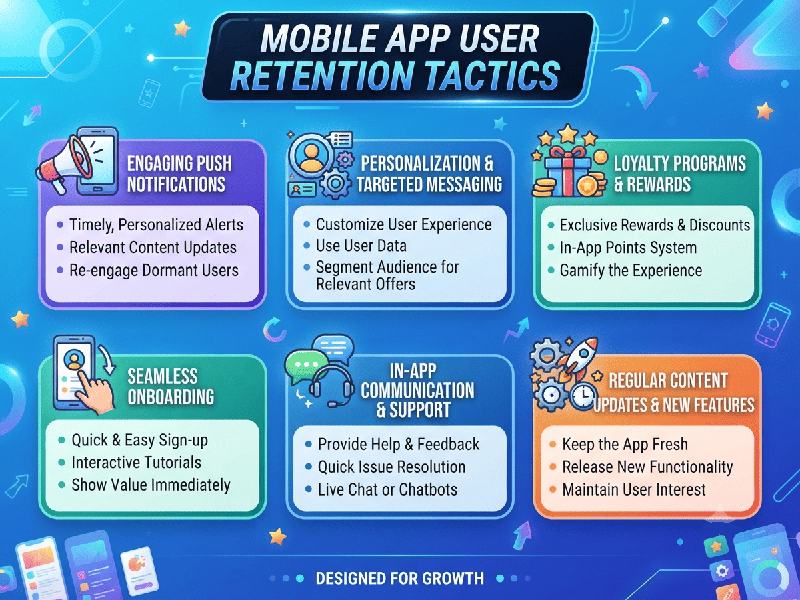
Mobile App User Retention Tactics
To effectively drive mobile app user retention in
2026, the focus has shifted from generic engagement to personalized,
value-driven, and predictive experiences.
The most successful retention strategies today rely on
a "Spike → Sustain → Sunset" model—capturing initial intent, building
habit loops, and respectfully managing inactive users.
1. Optimize the "Intent Capture" Window (Day
0–3)
The first few moments determine whether a user stays
or churns.
- Prioritize Time-to-Value: Map your "aha
moment"—the specific action that correlates with long-term
retention—and guide users to it as quickly as possible.
- Intent-Based Onboarding: Instead of generic tours, use
the first session to "triage" the user. Ask one high-value
question to understand their goals (e.g., "Are you here to buy,
learn, or browse?") and tailor the subsequent experience accordingly.
- Frictionless Sign-up: Use one-tap sign-in (Apple,
Google, passkeys) to lower barriers to entry.
2. Behavioral Segmentation & Personalization
"One-size-fits-all" messaging is a primary
driver of churn.
- Segment by Behavior: Group users based on actual
usage patterns (e.g., power users vs. dormant users) rather than static
demographic data.
- Predictive Personalization: Use on-device intelligence to
surface relevant actions, such as highlighting the last task a user worked
on or adjusting the home screen based on time of day.
- Targeted Re-engagement: If a user triggers (or fails to
trigger) a specific action, intervene immediately with a message
referencing that specific behavior, rather than waiting for a scheduled
blast.
3. Smart, Contextual Communication
Push notifications and in-app messages are effective
only when they feel like helpful nudges rather than noise.
- Trigger from Behavior: Send messages based on
real-world events—like cart abandonment, streak reminders, or booking
updates—that answer a live user need.
- Frequency Capping: Implement strict limits on
notification frequency to prevent fatigue and uninstallations.
- In-App Guidance: Use in-app messages to explain
new features or guide users through complex workflows while they
are active, which is often more effective than push notifications.
4. Build "Participation" Loops
The highest-retaining apps move users from being
passive consumers to active participants.
- Meaningful Gamification: Avoid "empty" points.
Use streaks, milestone badges, or progress bars that reflect genuine
accomplishment and tap into psychological triggers like loss aversion.
- Create Ownership: Invite users to contribute to
the product roadmap (e.g., voting on feature requests) so they feel
invested in the app’s evolution.
5. Technical Performance as a Feature
Retention is significantly impacted by how stable and
reliable your app feels.
- Proactive Monitoring: Use analytics to spot
"churn warnings" (diverging usage patterns) up to months before
they result in uninstalls.
- Offline Functionality: Ensure essential features work
without a connection and sync seamlessly once the user is back online.
- Continuous Updates: Treat the app as a living
product by shipping small, frequent fixes based on user feedback and
session performance.