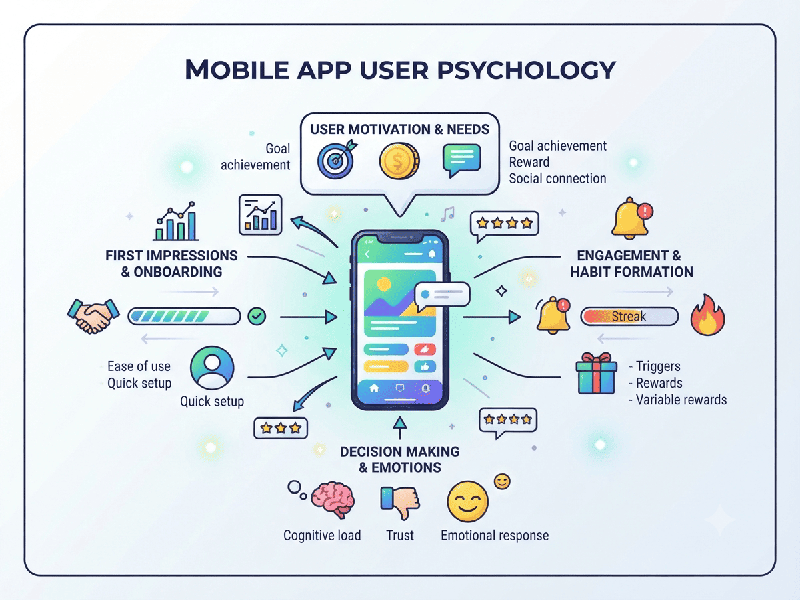
Mobile App User Psychology
Understanding mobile app user psychology comes down to
knowing how the human brain processes information, seeks rewards, and forms
habits. Successful apps don't just offer good features; they align perfectly
with our cognitive biases and emotional drivers.
Minimizing Cognitive Load
Cognitive load refers to the amount of mental effort
required to use an app. The human brain naturally conserves energy, meaning
users will abandon an app if it feels too complicated or overwhelming.
- Hick’s Law (The Paradox of
Choice): The
time and effort it takes to make a decision increases with the number of
choices available. Good apps fight this by offering a clean interface with
a single, clear Call to Action (CTA) per screen rather than a cluttered
menu.
- Frictionless Onboarding: Users want immediate value.
Forcing a user to read a 5-page tutorial or fill out a massive form
creates high cognitive load. Progressive disclosure—revealing features
only as the user needs them—keeps the brain from getting overwhelmed.
Key Psychological Triggers in Design
Beyond the habit loop, app designers rely on specific
cognitive biases to drive daily interactions:
- The Zeigarnik Effect: People remember incomplete
tasks better than completed ones. Apps leverage this by using progress
bars, onboarding checklists, and profile completion meters (e.g.,
"Your profile is 80% complete"). The brain craves the closure of
reaching 100%.
- Social Proof & FOMO: Humans are biologically wired
to look to the "tribe" to determine what is valuable. Features
that show how many friends are using an app, displaying user reviews, or
utilizing limited-time stories trigger the Fear Of Missing Out.
- Goal Gradient Effect: As people get closer to a
reward, they speed up their behavior to get it. A coffee app that gives
you a punch card with the first two "punches" already filled out
will see faster engagement than an empty card, even if the required number
of purchases is exactly the same.