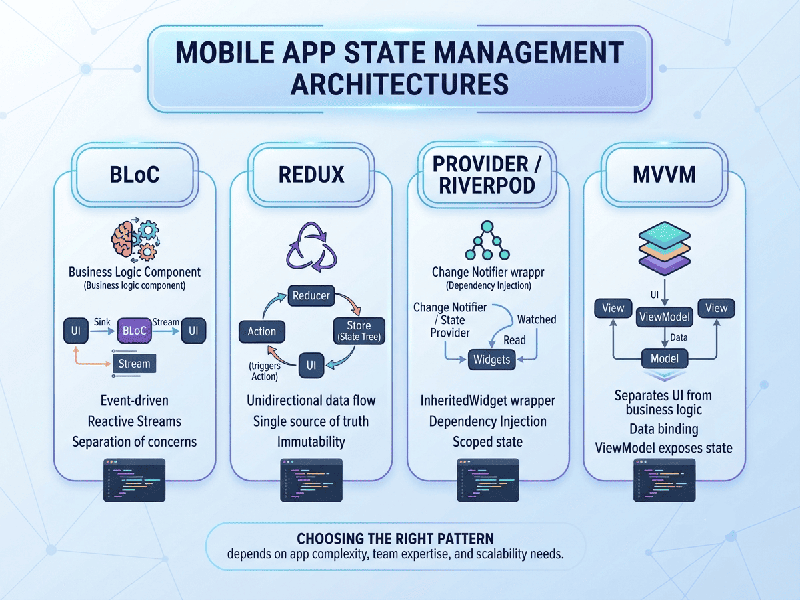
Mobile App State Management Architectures
Understanding Mobile App State Management
Architectures is crucial for building scalable, maintainable, and
high-performing applications. State management dictates how data flows, how UI
components react to changes, and how user actions update the underlying data
model.
What is State Management?
In mobile applications, State is any data that
can change over time when the user interacts with the app, or when background
processes fetch new data (e.g., network responses, form inputs, toggles, cached
data).
State management provides a predictable way to handle:
- Ephemeral State (Local/UI): Data needed only for a single
widget or screen (e.g., whether a text field is focused, a loading spinner
state).
- Application State
(Global/Shared):
Data needed across multiple screens or the entire app (e.g., user
authentication status, theme preferences, shopping cart items).
Core Architectural Patterns
Most state management solutions are built on top of a
few foundational design patterns:
- MVC (Model-View-Controller): The traditional pattern where
the Controller handles user input, updates the Model, and the View renders
the data. Can lead to "Massive View Controllers" in mobile apps.
- MVVM (Model-View-ViewModel): Highly popular in modern mobile
development (Jetpack Compose, SwiftUI, Flutter). The ViewModel exposes
streams of data (observables/states) to the View, keeping UI components
decoupled from business logic.
- BLoC / Component-Based: Uses reactive programming
(Streams/Observables) where UI components send Events to a central
processor (BLoC), which transforms them and yields a new State.
- Redux / Unidirectional Data Flow
(UDF): State is
kept in a single immutable store. Actions are dispatched to reducers,
which compute the new state, triggering a predictable UI re-render.
Ecosystem-Specific Solutions
Depending on whether you are building cross-platform
or native apps, the tooling changes:
1. Flutter
- Provider: A lightweight, easy-to-use
wrapper around InheritedWidgets, ideal for dependency injection and
simple-to-medium state management.
- BLoC (Business Logic Component): The industry standard for large
enterprise Flutter apps, enforcing strict separation of concerns via
reactive streams.
- Riverpod: A modern, robust evolution of
Provider that is compile-safe and eliminates context dependency.
2. React Native
- Redux Toolkit (RTK): The standard tool for
predictable state containers, great for complex global states.
- Zustand / Jotai: Minimalist, hooks-based state
management libraries that drastically reduce boilerplate compared to
Redux.
- React Query (TanStack Query): The gold standard specifically
designed for managing, caching, and syncing server state (API
data).