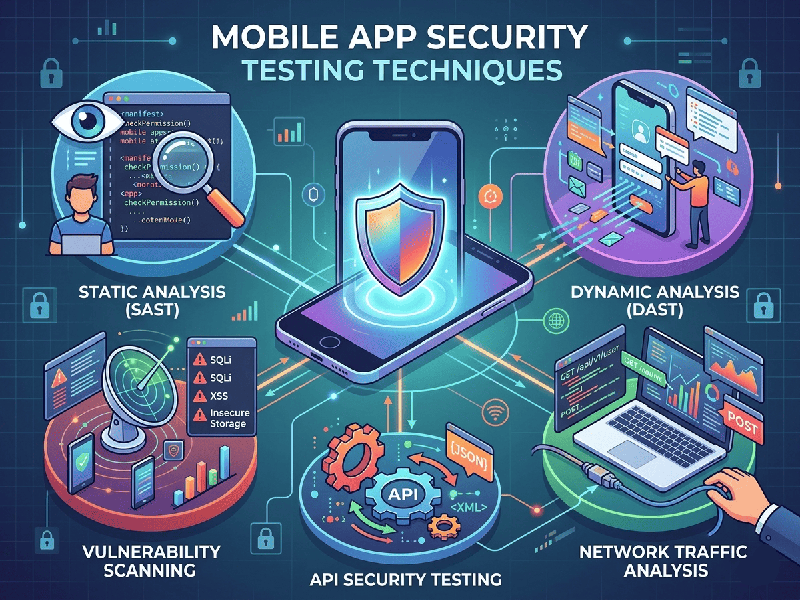
Mobile App Security Testing Techniques
Mobile app security testing has evolved from periodic audits
to continuous, automated validation integrated into the DevSecOps
pipeline. With the rise of AI-generated code and decentralized app
distribution, the focus has shifted toward runtime resilience and API-centric
security.
1. Automated Static Analysis (SAST) & SCA
Static Analysis involves inspecting the application’s code or
binary without executing it. In 2026, this is the "first gate" in the
CI/CD pipeline.
- AI-Enhanced Scanning: Modern SAST tools now use LLMs
to reduce false positives and identify complex logic flaws that
traditional pattern-matching missed.
- Software Composition Analysis
(SCA): Since
apps rely heavily on third-party SDKs, SCA scans for known vulnerabilities
in dependencies and checks for "leaky" telemetry or malicious
background behaviors in open-source libraries.
- Secret Detection: Automated checks for hardcoded
API keys, certificates, or tokens within the source code or configuration
files.
2. Dynamic Analysis (DAST) & IAST
Dynamic Analysis tests the app while it is running, usually
on a physical device or a high-fidelity emulator.
- Network Interception: Using tools like mitmproxy
or Burp Suite to analyze traffic between the app and the backend,
checking for weak TLS configurations or lack of certificate pinning.
- Interactive Analysis (IAST): Hybrid testing where an agent
inside the app reports vulnerabilities in real-time as a tester (or
automated script) interacts with the UI.
- Platform Interaction: Testing how the app handles
local storage (e.g., Android Keystore, iOS Secure Enclave) and whether
sensitive data is leaked through screenshots, backups, or system logs.
3. Resilience & Reverse Engineering Testing
This is the "Breaker" mindset, focusing on how well
an app can defend itself in a hostile environment (like a rooted or jailbroken
device).
- Anti-Tampering Checks: Verifying that the app can
detect if its binary has been modified or if it is being run under a
debugger.
- Obfuscation Testing: Ensuring that the code is
sufficiently scrambled so that an attacker cannot easily reverse-engineer
the business logic or extraction of proprietary algorithms.
- Root/Jailbreak Detection: Testing if the app correctly
restricts sensitive features (like payments) when it detects a compromised
OS.
4. API Security Testing (The "Backend-First" Shift)
In 2026, the mobile app is often just a thin client; the real
risk is the API.
- BOLA/BFLA Detection: Testing for Broken Object
Level Authorization to ensure one user cannot access another user's
data by simply changing an ID in a request.
- Fuzzing: Sending massive amounts of
malformed data to API endpoints to check for buffer overflows or unhandled
exceptions.
- Behavioral Analytics: Testing the backend's ability
to detect anomalous API usage patterns (e.g., a single user account
hitting 500 requests in 5 seconds).
5. Compliance-Based Testing (MASVS)
Testing is now standardized under the OWASP Mobile
Application Security Verification Standard (MASVS).
- Level 1 (L1): Standard security for all apps
(no hardcoded secrets, proper encryption).
- Level 2 (L2): Defense-in-depth for high-risk
apps like Banking or Healthcare (Biometric security, advanced session
management).
- Category R (Resilience): Mandatory for apps that need to
resist reverse engineering and IP theft.