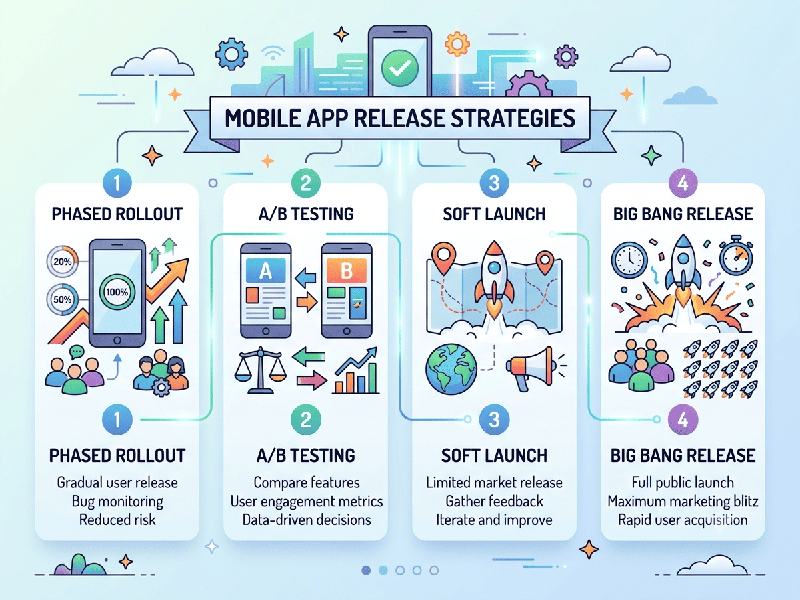
Mobile App Release Strategies
Mobile App Release Strategies define how app updates or initial launches are deployed to users while minimizing technical risk, protecting app store reviews, and ensuring server stability.
Core Mobile App Release Strategies
1. Phased / Staged Rollouts
Releasing an update to a small, incremental percentage
of users over several days rather than publishing to 100% of the audience at
once.
- How It Works:
o Google Play: Flexible staged rollouts (e.g., 1%
o Apple App Store: Automatic Phased Release over a
fixed 7-day period (Day 1: 1%, Day 2: 2%, Day 3: 5%, Day 4: 10%, Day 5: 20%,
Day 6: 50%, Day 7: 100%).
- Best Used For: Standard production updates and
feature enhancements.
- Primary Benefit: Early detection of crash
spikes, API load issues, or severe bugs before they impact the broader
user base.
2. Beta Testing & Internal Rings (Closed vs. Open
Releases)
Deploying pre-release builds to specific test groups
using platforms like TestFlight (iOS) or Google Play Internal/Beta Track
(Android).
- Internal / Alpha Releases: Shared only with employees,
developers, and internal stakeholders to verify functional requirements.
- Closed Beta: Distributed to a trusted group
of external users via direct invitation or email lists to gather early
usability feedback.
- Open Beta: Accessible to any public user
through a direct store link, allowing heavy-stress testing of servers and
scaling mechanisms.
3. Soft Launch / Geographic Rollout
Launching the fully functional app in smaller,
representative markets before opening up to primary target regions.
- How It Works: Releasing in tier-2 or tier-3
markets that mirror user behaviors of primary markets (e.g., launching in
Canada, Australia, or New Zealand before a US launch).
- Best Used For: Brand-new apps, mobile games,
or major architectural platform overhauls.
- Primary Benefit: Validates retention metrics,
unit economics, and backend infrastructure under real production
conditions without risking brand reputation in primary markets.
4. Feature Flag Controlled Release (Dark Launching)
Deploying code to production environments with new
features disabled behind remote configuration toggles (e.g., LaunchDarkly,
Firebase Remote Config).
- How It Works: The app binary contains the
code, but specific user cohorts (e.g., VIP users, 10% sample size) are
dynamically enabled server-side without submitting a new build to the app
stores.
- Best Used For: High-risk features, A/B
testing, and complex backend integration releases.
- Primary Benefit: Allows instant feature
kill-switches without waiting for app store approval processes.