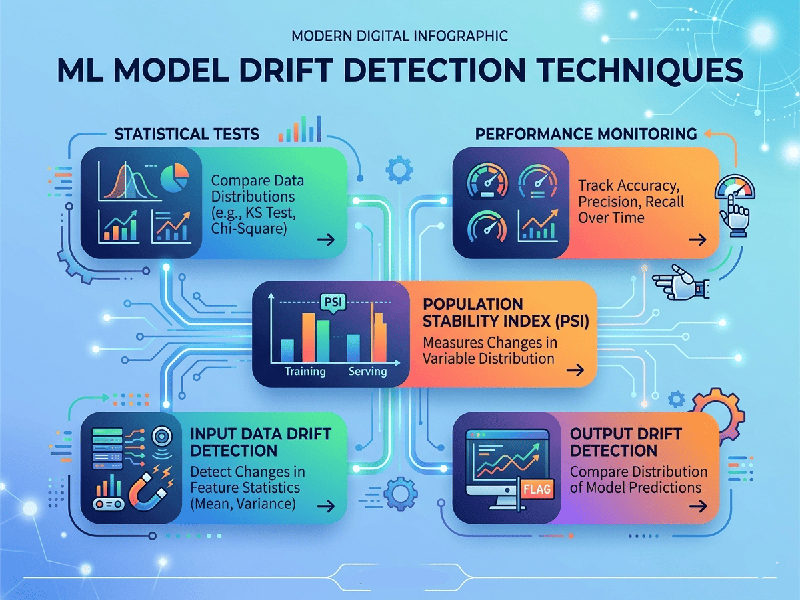
ML Model Drift Detection Techniques
ML model drift (also known as concept drift or data drift)
occurs when the statistical properties of the target variable or the input data
change over time, leading to a degradation in the model's predictive
performance.
Detecting this drift is critical for maintaining model
reliability in production environments. Here are the primary techniques
categorized by their approach:
1. Statistical Distribution Monitoring (Data Drift)
These methods compare the distribution of the production data
(live) against the training data (reference). If the statistical properties
shift, it often serves as a "leading indicator" that performance may
soon decline.
- Population Stability Index
(PSI): Measures
the shift in the distribution of a variable over time. A common rule of
thumb is that a PSI < 0.1 indicates no significant change, 0.1–0.25
indicates moderate change, and > 0.25 indicates significant drift.
- Kullback-Leibler (KL)
Divergence: A
measure of how one probability distribution differs from a reference
distribution. It is highly sensitive to changes in probability density.
- Kolmogorov-Smirnov (K-S) Test: A non-parametric test that
compares the cumulative distribution functions of two datasets. It is
excellent for detecting shifts in continuous numerical variables.
- Jensen-Shannon Divergence: A symmetric and smoothed
version of the KL divergence, often preferred for its stability.
2. Performance-Based Monitoring (Concept Drift)
These methods measure actual model error. While these are the
most direct ways to detect drift, they often suffer from feedback delay
(the time it takes to obtain ground truth labels).
- Prediction Error Tracking: Monitoring metrics like Mean
Squared Error (MSE), Mean Absolute Error (MAE), or Accuracy over a sliding
window.
- Confusion Matrix Analysis: Monitoring changes in
Precision, Recall, and F1-score. A sudden drop in these metrics is a
definitive sign that the relationship between features and the target has
changed.
3. Machine Learning-Based Detectors
These methods use a "detector" model to determine
if incoming data samples are indistinguishable from training data.
- Adversarial Validation: Train a binary classifier to
distinguish between training data and production data. If the classifier
can accurately tell the difference (achieving high AUC), it means the
production data has drifted from the training set.
- Unsupervised Drift Detection: Using autoencoders or
clustering algorithms (e.g., K-Means). If the model's reconstruction error
increases on new data or if data points fall into new, unexpected
clusters, drift is likely occurring.