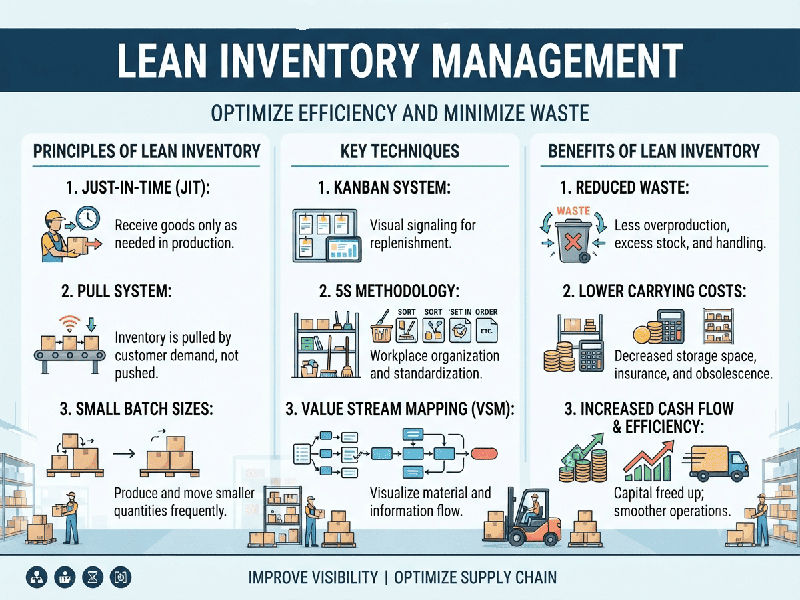
Lean Inventory Management
Lean Inventory Management is a strategic supply chain approach
focused on minimizing inventory levels and waste while maximizing efficiency
and maintaining product availability. Rooted in the Toyota Production System
(TPS), it operates on the principle that holding excess stock ties up working
capital, incurs storage costs, and masks underlying operational inefficiencies.
1. The Core Principles of Lean Inventory
Lean inventory relies on a shift from traditional
"just-in-case" warehousing to precise, demand-driven operations:
- Elimination of Waste (Muda): Identifying and removing
activities or resources that do not add value to the customer—specifically
excessive storage, overproduction, and obsolete stock.
- Pull-Based Replenishment: Producing or ordering goods
only in response to actual customer demand rather than forecasted
predictions.
- Continuous Improvement (Kaizen): Regularly auditing supply chain
processes, supplier reliability, and fulfillment speeds to steadily reduce
lead times and buffer stocks.
2. Key Strategies & Techniques
To keep inventory lean without risking stockouts,
organizations implement several core methodologies:
- Just-In-Time (JIT) Inventory: Receiving materials and goods
only as they are needed in the production process or for customer
fulfillment.
- Kanban Systems: Using visual signals, cards, or
digital triggers to signal when inventory needs to be replenished along
the supply chain.
- Vendor-Managed Inventory (VMI): Shifting inventory monitoring
and replenishment responsibilities to the supplier, who tracks stock
levels and restocks automatically based on agreed parameters.
- Consignment Inventory: Storing supplier-owned stock at
your facility, meaning you only pay for the items once they are used or
sold.
- ABC Analysis: Categorizing inventory by value
and turnover (A-items: high value, low quantity; C-items: low value, high
quantity) to apply stricter controls to the most critical stock.
3. Benefits of Lean Inventory
- Reduced Carrying Costs: Lowers warehouse rental fees,
insurance, handling expenses, and the risk of inventory obsolescence or
damage.
- Improved Cash Flow: Frees up capital that would
otherwise be tied up in dead stock or excess raw materials, allowing funds
to be reinvested into growth.
- Higher Operational Agility: Forces businesses to identify
supply chain bottlenecks quickly, resulting in faster lead times and more
responsive customer service.
4. Risks and Challenges
- Supply Chain Vulnerability: Highly lean systems leave
little room for error. Unforeseen disruptions—such as geopolitical
conflicts, carrier strikes, or severe weather—can cause immediate
stockouts and halt operations.
- Inaccurate Forecasting: Because lean models rely on
tight safety margins, a sudden, unpredicted spike in demand can quickly
overwhelm fulfillment capabilities.