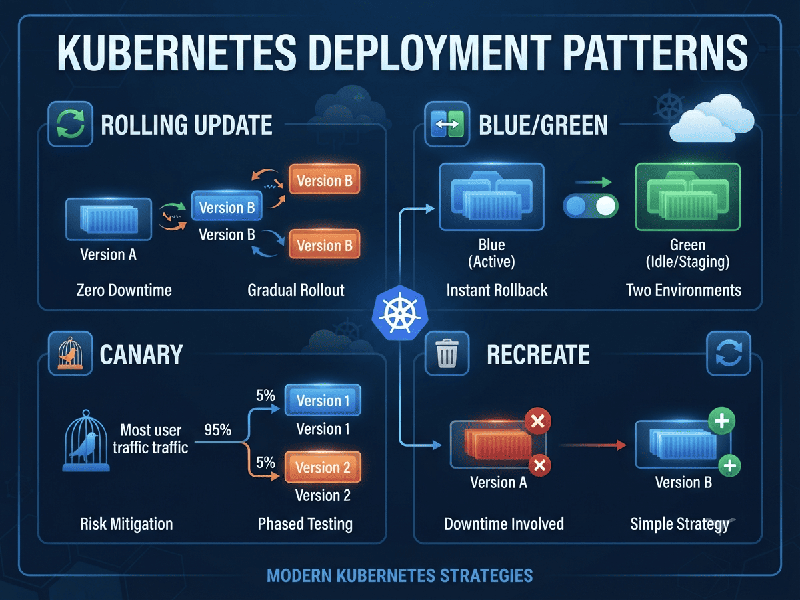
Kubernetes Deployment Patterns
Selecting the right deployment pattern in Kubernetes
is essential for balancing application availability, risk mitigation, and
resource efficiency. Kubernetes provides native primitives to execute various
release strategies, while advanced patterns can be orchestrated using services,
ingresses, or service meshes.
Native Kubernetes Strategies
1. Rolling Update (Default Strategy)
- How it works: Kubernetes incrementally
replaces old pods with new ones. It controls the rollout using maxSurge
(how many pods can be created above the desired replica count) and
maxUnavailable (how many pods can be offline during the update).
- Pros: Achieves zero-downtime updates
natively without requiring duplicate infrastructure.
- Cons: Both versions of the
application run simultaneously and serve traffic concurrently for a brief
window, which requires backward and forward compatibility for APIs and
databases.
2. Recreate Strategy
- How it works: Kubernetes terminates all
existing pods simultaneously before spinning up any new pods.
- Pros: Simple to implement; guarantees
that only one version of the application code runs at any given moment
(ideal for breaking database schema migrations).
- Cons: Causes explicit application
downtime during the transition. Recommended only for non-production
environments or maintenance windows.
3. Blue/Green Deployment
- How it works: You maintain two identical
production environments (Blue and Green). The live environment handles
production traffic while the new version is deployed and tested on the
idle environment. Once validated, a Kubernetes Service selector is
switched to point instantly to the new version.
- Pros: Instant rollback capability
(just switch the service selector back); zero ambiguity during testing
since the entire stack is validated beforehand.
- Cons: Requires double the cluster
resources during the deployment window.
4. Canary Deployments
- How it works: A small fraction of user
traffic (e.g., 5% to 10%) is routed to a newly deployed version while the
vast majority continues hitting the stable baseline version. Metrics and
logs are monitored before gradually scaling up the canary deployment to
100%.
- Pros: Drastically minimizes blast
radius if a bug slips into production.
- Cons: Requires advanced traffic
routing mechanisms via an Ingress controller, Service Mesh (like Istio or
Linkerd), or specialized tooling (like Argo Rollouts).
5. Shadow (Dark) Deployments
- How it works: The new version runs alongside
the production version, receiving a mirrored, asynchronous copy of
incoming live traffic. Responses from the shadow version are discarded
before reaching the user.
- Pros: Excellent for real-world load
testing, debugging performance anomalies, and stress-testing new builds
under authentic production traffic without user impact.
- Cons: High resource consumption; risk
of duplicate side-effects (e.g., accidental duplicate database writes) if
traffic mirroring is not carefully managed.
Production Best Practices for Safe Rollouts
- Always Couple with Readiness
Probes: Ensure
custom readiness probes are defined so Kubernetes knows when a
newly updated pod is genuinely ready to accept traffic before terminating
older instances.
- Implement GitOps Workflows: Manage deployment manifests
declaratively in Git (using tools like ArgoCD or Flux) to maintain a
single source of truth and effortless audit trails.
- Set Termination Grace Periods: Explicitly configure
terminationGracePeriodSeconds to give running connections and background
workers enough time to complete cleanly before a pod shuts down.