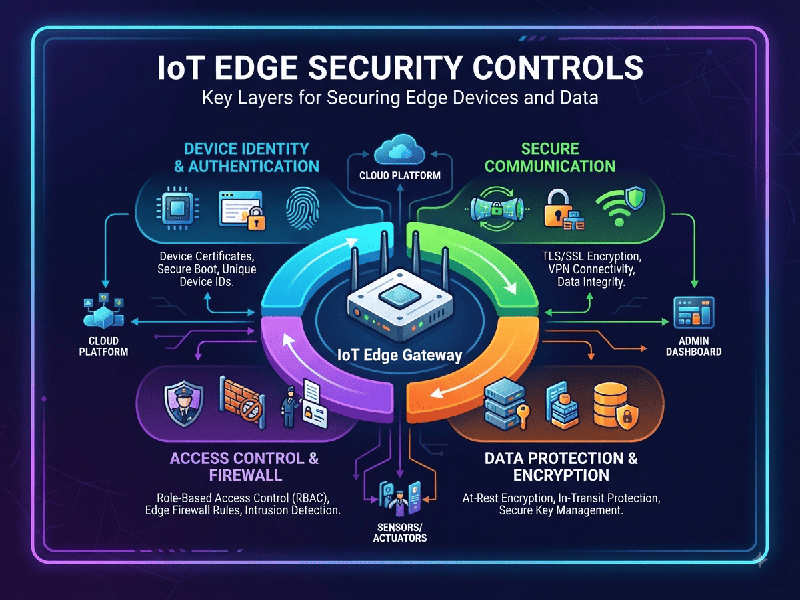
IoT Edge Security Controls
IoT edge security controls are the specific hardware,
software, and cryptographic mechanisms used to protect Internet of Things (IoT)
devices, gateways, and local edge computing infrastructure from cyber threats.
Because edge devices operate outside the secure perimeter of traditional
corporate data centers—often deployed in remote, unmonitored, or physically
accessible locations—robust edge security is essential to prevent device
hijacking, data theft, and lateral attacks into the main enterprise network.
Core Pillars of IoT Edge Security
1.
Hardware-Root of Trust & Secure Boot:
o Utilizes specialized hardware chips
(such as a Trusted Platform Module or secure element) to cryptographically
verify the device's firmware and operating system during startup, ensuring the
device hasn't been tampered with before execution.
2.
Device Identity & Authentication:
o Assigns unique, cryptographic
certificates or keys to every edge device, ensuring that only authenticated
devices can connect to the local network or cloud endpoints.
3.
Data Encryption (At Rest and In Transit):
o Encrypts local storage and logs to
protect sensitive data if a device is physically stolen. All communication
between edge nodes, gateways, and the cloud must use secure protocols (such as
TLS 1.3 or mutual TLS - mTLS).
4.
Secure Firmware Over-The-Air (FOTA) Updates:
o Establishes automated, encrypted
channels to push security patches and firmware updates to remote devices
safely, preventing "man-in-the-middle" attacks during update cycles.
5.
Network Segmentation & Zero Trust Architecture:
o Isolates edge devices on restricted
local subnets, blocking unnecessary inbound and outbound ports, and enforcing
the principle of least privilege for all internal and external API calls.
Key Best Practices for Edge Implementation
- Physical Security Measures: Protect physical ports (like
USB or Ethernet jacks) and enclosures with tamper-detection switches or
physical lockouts if devices are deployed in public areas.
- Continuous Monitoring &
Threat Detection: Deploy lightweight security agents or log collectors at the edge to
monitor for anomalous behavior, unusual traffic spikes, or unauthorized
configuration changes.
- Automated Credential Rotation: Regularly update and rotate
cryptographic keys and access tokens automatically to minimize the window
of vulnerability if a single credential is compromised.