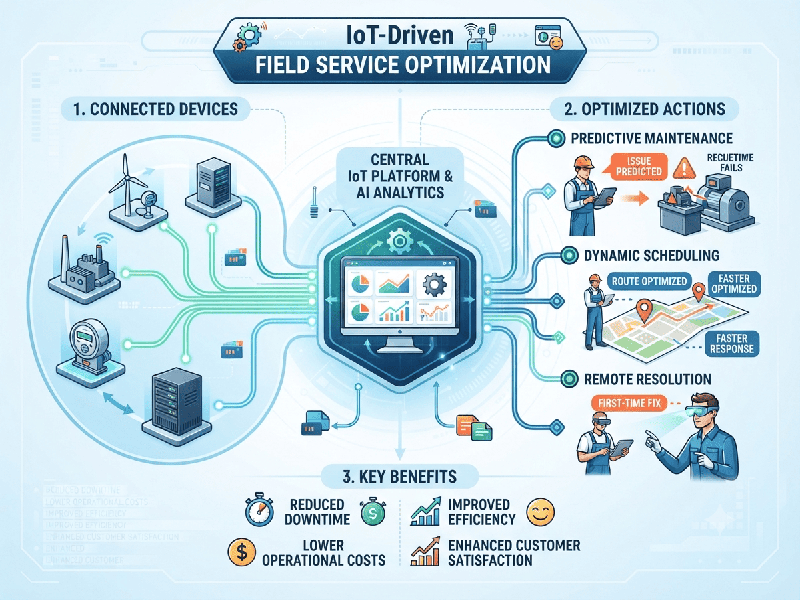
IoT-Driven Field Service Optimization
IoT-Driven Field Service Optimization refers to the integration of the
Internet of Things (IoT) into field service management (FSM) systems. Instead
of reacting when equipment breaks down (reactive service), companies use smart
sensors on connected devices to monitor performance in real-time, predict
failures, and automatically dispatch technicians with the right parts before a
breakdown happens.
Core Objectives
- Shift from Reactive to
Predictive:
Move away from costly emergency repairs toward scheduled, proactive
maintenance.
- Maximize First-Time Fix Rates: Ensure field technicians arrive
equipped with the exact diagnostic data and replacement parts needed on
the first visit.
- Minimize Downtime: Keep customer assets running
continuously by catching mechanical or software issues early.
Key Components of IoT Field Service
- Smart Sensors & Edge
Devices:
Physical sensors attached to machinery (e.g., pumps, HVAC units, medical
equipment) that track temperature, vibration, pressure, and operational
hours.
- Cloud & IoT Platforms: The centralized software layer
that collects, aggregates, and analyzes telemetry data streaming from
thousands of remote assets.
- AI & Predictive Analytics: Algorithms that establish
baseline performance and flag anomalies that indicate a part is wearing
out.
- Automated Dispatch Engine: FSM software that links alert
triggers directly to scheduling tools to assign the nearest, most
qualified technician.
How the Workflow Operates
1.
Continuous Monitoring: IoT sensors monitor equipment health 24/7 in real time.
2.
Anomaly Detection: A sensor detects abnormal vibration or overheating, predicting an
impending motor failure.
3.
Automated Work Order Generation: The IoT platform automatically signals the ERP/FSM system to
create a work order and suggest required spare parts.
4.
Smart Dispatching: The system checks technician locations, skills, and traffic, routing the
best available worker to the site.
5.
Resolution & Feedback: The technician services the asset, updates the system, and
closes the loop, updating inventory and asset history.
Key Benefits
- Reduced Operational Costs: Fewer truck rolls (unnecessary
site visits) and elimination of catastrophic, expensive asset failures.
- Enhanced Customer Satisfaction: Guaranteed higher uptime and
proactive communication before the customer even notices a performance
drop.
- Optimized Inventory Management: Warehouses stock only the
high-demand parts predicted by real-world IoT data trends.