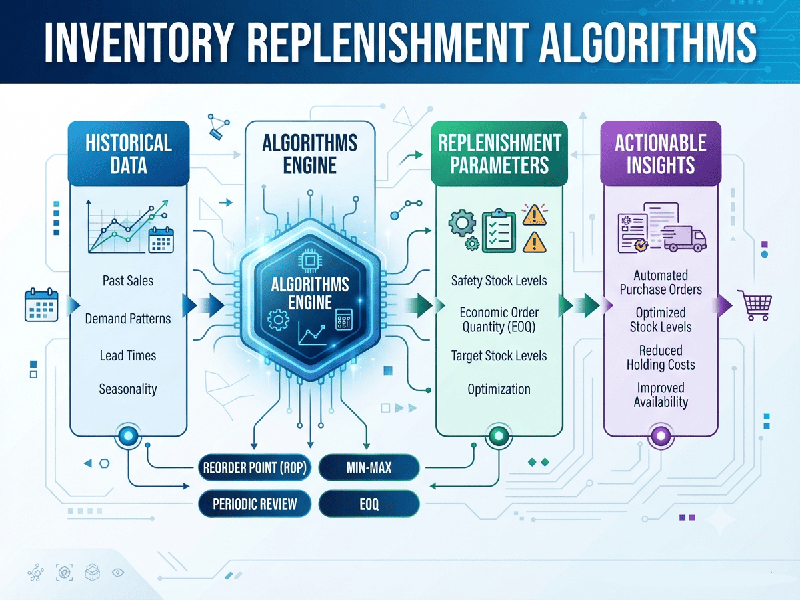
Inventory Replenishment Algorithms
Inventory replenishment algorithms are automated
mathematical models used by supply chain and enterprise resource planning (ERP)
systems to determine when to reorder stock and how much to order.
The primary goal is to maintain optimal inventory levels—preventing stockouts
(lost sales) while minimizing carrying costs and excess capital tied up in
warehouse stock.
Core Types of Replenishment Algorithms
1. Reorder Point (ROP) & Safety Stock
- How it works: Triggers a reorder whenever the
inventory position (on-hand + on-order - backorders) drops to a specific
threshold, known as the Reorder Point.
- Formula:
- Best used for: Stable, predictable demand
items with steady lead times.
2. Economic Order Quantity (EOQ)
- How it works: A formula-driven approach that
calculates the ideal order quantity minimizing the total costs of
inventory—specifically the trade-off between holding costs
(storage, insurance, depreciation) and ordering costs (shipping,
handling, administrative processing).
- Formula:
(Where
- Best used for: Organizations looking to
minimize transactional and holding expenses for steady-demand inventory.
3. Periodic Review System (Min-Max System)
- How it works: Instead of continuously
monitoring stock levels, inventory is checked at fixed time intervals
(e.g., every Monday or the 1st of every month). If stock has fallen below
a pre-set minimum threshold, an order is placed to bring inventory back up
to the maximum level.
- Best used for: Joint deliveries, routine
supplier route schedules, or retail environments where continuous tracking
is impractical.
4. Demand-Driven & Predictive Algorithms (Machine
Learning)
- How it works: Advanced algorithms that go
beyond historical averages by factoring in external variables like
seasonality, marketing promotions, macroeconomic indicators, and real-time
point-of-sale (POS) data to dynamically adjust safety stock and order
schedules.
- Best used for: Complex supply chains,
fluctuating demand patterns, e-commerce, and perishable goods.
Key Benefits
- Reduction of Carrying Costs: Prevents over-ordering and ties
up less working capital in dead or slow-moving stock.
- Mitigation of Stockouts: Ensures high inventory
availability for high-demand or critical items, improving service levels
and customer satisfaction.
- Operational Efficiency: Automates routine purchasing
decisions, freeing supply chain teams to focus on strategic vendor
management and exception handling.