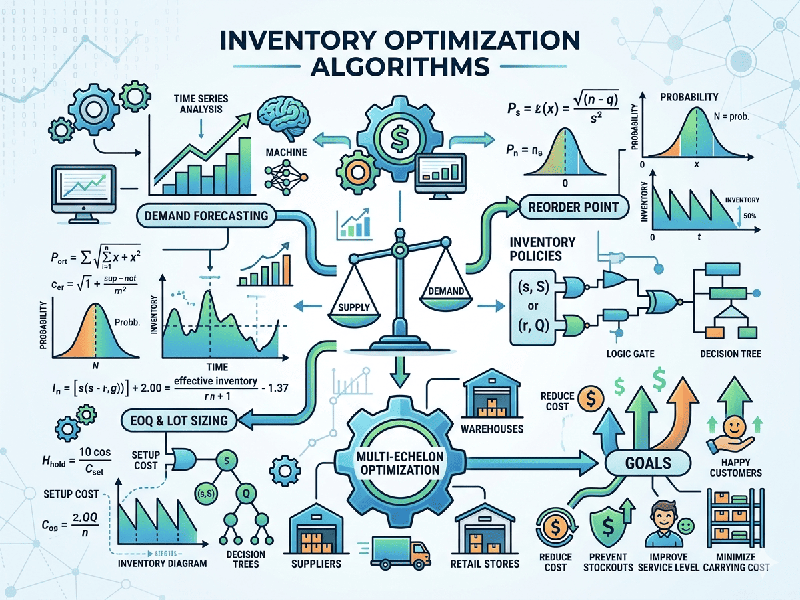
Inventory Optimization Algorithms
Inventory optimization is the process of maintaining the
exact right amount of stock to meet customer demand while minimizing the costs
of holding that inventory. Holding too much stock ties up working capital and
risks obsolescence, while holding too little leads to stockouts, delayed
shipments, and lost revenue.
Modern supply chain management relies on math-driven
algorithms to balance these trade-offs, turning inventory management from a
guessing game into a predictable science.
The Strategic Balance: Why Math Matters
Every inventory manager faces a constant battle between
supply, demand, and capital constraints. Algorithms look at your historical
sales data, supplier performance, and shipping timelines to find the ideal
balance.
1. Classical Deterministic Models
Deterministic models assume that demand and lead times are
constant and predictable. While simple, they form the foundational baseline for
inventory logic.
Economic Order Quantity (EOQ)
The EOQ algorithm calculates the absolute most cost-effective volume of inventory to order at one time. It minimizes the total costs associated with both ordering stock (shipping, handling, processing) and holding stock (warehouse space, insurance).
Just-In-Time (JIT) & Kanban Pull Systems
Popularized by manufacturing giants, JIT minimizes inventory
levels by scheduling stock to arrive only when it is needed in the
production cycle. Rather than pushing inventory based on vague forecasts, a
Kanban algorithm pulls stock through the supply chain based on real-time
consumption signals.
2. Stochastic & Dynamic Risk Models
In the real world, demand spikes unexpectedly and suppliers
run late. Stochastic models introduce probability distributions to account for
this randomness.
Safety Stock & Reorder Point (ROP) Calculation
The Reorder Point tells you exactly when to place a
new purchase order so you do not dip into your emergency safety stock before
the new shipment arrives.
Multi-Echelon Inventory Optimization (MEIO)
If your business manages inventory across multiple
locations—like an overseas manufacturing hub, three regional fulfillment
centers, and dozens of retail stores—optimizing each location independently
causes massive inefficiencies.
MEIO algorithms look at your entire supply chain network as a
single ecosystem. It models how inventory levels at your central warehouse
impact stockouts at local retail locations, shifting the buffer stock upstream
or downstream to minimize total system-wide holding costs.
3. Algorithmic Categorization: ABC-XYZ Matrix
Not all inventory items deserve equal analytical attention.
An ABC-XYZ matrix uses algorithmic sorting to segment your stock based on two
distinct dimensions:
- ABC Analysis (Value): Based on the Pareto Principle
(the 80/20 rule), it ranks items by their total financial value
contribution (A = High value, B = Medium value, C = Low value).
- XYZ Analysis (Predictability): Ranks items by the volatility of their demand (X = Constant/Easy to forecast, Y = Variable/Seasonal, Z = Highly erratic/Frequent zero-demand periods).