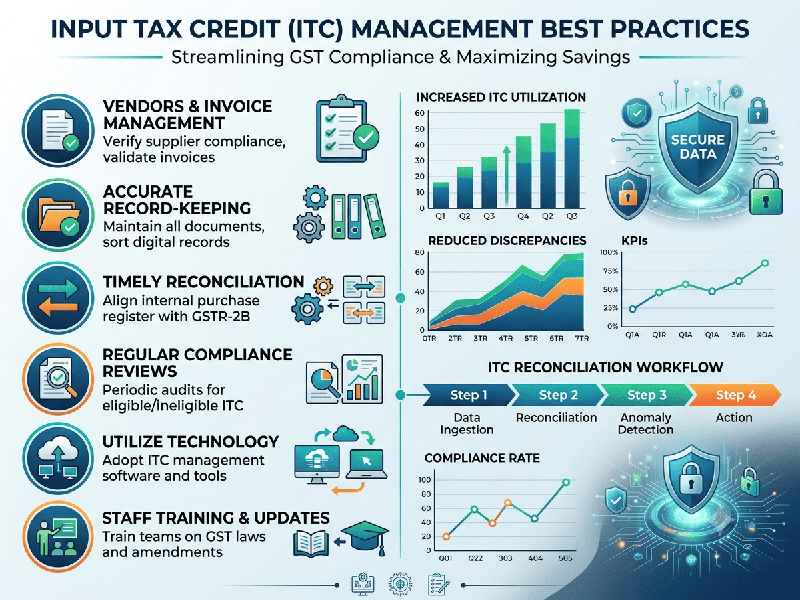
Input Tax Credit (ITC) Management Best Practices
An effective Input Tax Credit (ITC) management
strategy balances maximizing working capital with strict legal compliance under
the CGST Act. Mismanaged ITC leads to either tax credit leakages or tax
notices, interest (18% p.a.), and penalties for excess claims.
Core Pillars of ITC Management
1. Real-Time Vendor Compliance Tracking
Under Section 16(2)(aa), ITC is legally available only
if the vendor reports the invoice in their GSTR-1 and it auto-populates
into your GSTR-2B.
Vendor Onboarding Verification: Verify the active status and
historical compliance rating of new suppliers using the GST portal API.
Payment Holds: Add contractual clauses to withhold the tax portion of
supplier payments until the invoice reflects in GSTR-2B.
Automated Non-Compliance Alerts: Dispatch automated reminders
(WhatsApp, SMS, Email) to vendors whose invoices are missing from GSTR-2B
before return filing deadlines.
2. The 180-Day Rule Monitoring
According to the second proviso to Section 16(2), if a
recipient fails to pay the supplier the invoice value plus tax within 180
days from the invoice date, the ITC claimed must be reversed along with
interest.
Ageing Analysis: Set up 120-day and 150-day tracking alerts in your
accounts payable workflow for all unpaid invoices.
Auto-Reversal System: Ensure your ERP automatically flags
unpaid invoices reaching 180 days to reverse the ITC in GSTR-3B Table 4(B)(2)
and reclaim it once payment is processed.
3. Managing Common vs. Exempt Supplies (Rule 42 &
43)
If a business makes both taxable and exempt supplies
(or uses inputs for both business and non-business purposes), ITC must be
proportionately reversed under Rules 42 (Inputs/Input Services) and 43 (Capital
Goods).
Monthly Reversals: Calculate and report provisional monthly reversals in
GSTR-3B.
Annual True-Up: Re-calculate aggregate common ITC reversals annually before
the 30th of November following the financial year end to account for short or
excess reversals.