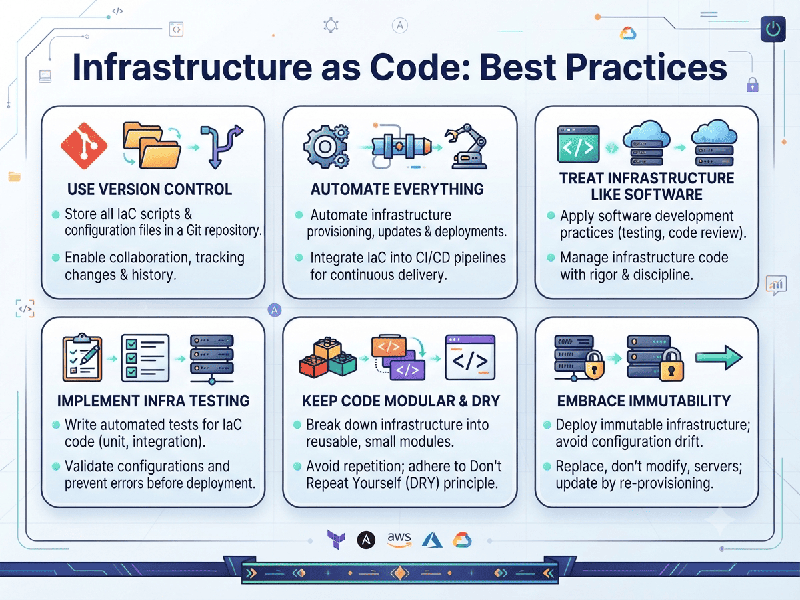
Infrastructure as Code: Best Practices
Achieving success with Infrastructure as Code (IaC)
requires treating infrastructure definitions with the same rigorous engineering
standards as application code.
1. Version Control Everything
- Store all code in Git: Keep your templates,
configuration scripts, and definition files in a version control system.
- Use Pull/Merge Requests: Enforce code reviews for every
infrastructure change to catch errors early and share knowledge across the
team.
- Implement Branching Strategies: Use feature branches for
testing new infrastructure changes before merging them into production
branches.
2. Automate Testing and Validation
- Static Analysis: Use linters (e.g., tflint) and
formatters to catch syntax errors and enforce style guides automatically.
- Policy as Code: Integrate tools like OPA (Open
Policy Agent) or Checkov to scan code for security vulnerabilities,
compliance violations, and misconfigurations before deployment.
- Automated Testing: Run unit tests and integration
tests in staging environments using tools like Terratest.
3. Embrace Immutability
- Avoid In-Place Updates: Instead of modifying running
servers or resources, replace them entirely with newly provisioned,
updated instances.
- Minimize Configuration Drift: Ensure your code is the single
source of truth. If manual changes are made in a cloud console, they
should be overwritten or flagged by your IaC pipeline.
4. Modularize and Re-use Code
- DRY Principle (Don't Repeat
Yourself):
Break large monolithic scripts into smaller, reusable modules (e.g., a
standardized module for creating a secure database or VPC).
- Registry/Library: Maintain a private or public
repository of version-controlled, organization-approved modules to
accelerate deployment.
5. Secure State Management
- Remote State Storage: Never store state files
locally. Use secure, centralized remote backends (e.g., AWS S3 with
DynamoDB locking, Terraform Cloud, or Azure Blob Storage).
- State Encryption: Ensure state files—which often
contain sensitive data like passwords and keys—are encrypted at rest and
in transit.
- Access Control: Restrict who can read, write,
or lock the state file using strict IAM policies.
6. Implement CI/CD Pipelines
- Automated Deployments: Eliminate manual apply commands
from local machines. Use CI/CD pipelines (GitHub Actions, GitLab CI,
Jenkins) to run deployments consistently.
- Plan and Apply Stages: Always configure pipelines to
generate and review an execution plan (terraform plan) automatically
before requiring manual approval for the apply stage.
7. Manage Secrets Securely
- Never Hardcode Secrets: Avoid placing passwords, API
tokens, or SSH keys directly in your IaC files.
- Integrate Secret Managers: Fetch secrets dynamically at
runtime from secure vaults such as HashiCorp Vault, AWS Secrets Manager,
or Azure Key Vault.