Identity & Access Management Best Practices
Identity and Access Management (IAM) is the
foundational security discipline that ensures the right people and systems have
the appropriate access to resources. To build a robust security posture in
2026, organizations must move beyond simple password management toward a Zero
Trust framework.
Core IAM Best Practices
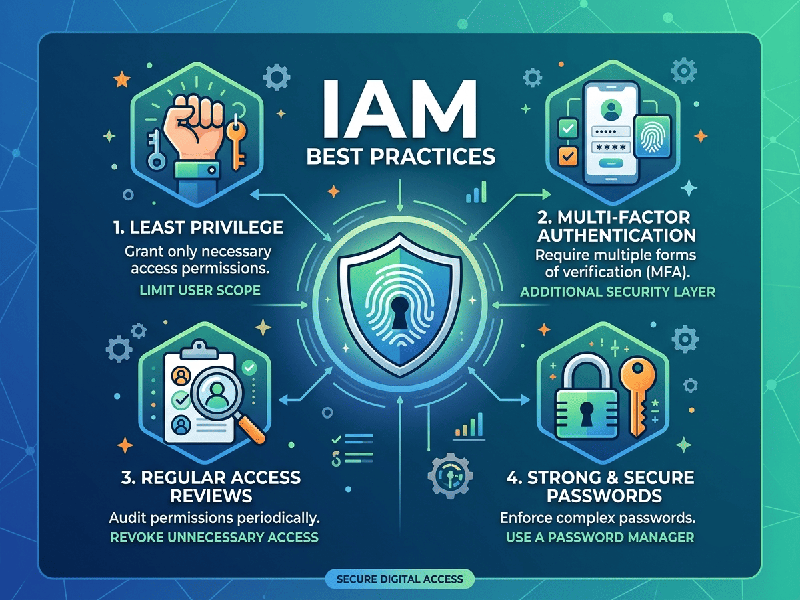
- Adopt the Principle of Least
Privilege (PoLP): Grant users and machine identities only the minimum access
necessary to perform their specific job functions. Regularly audit and
prune excessive permissions.
- Implement Multi-Factor
Authentication (MFA): Require at least two forms of verification for every access
attempt. Shift toward phishing-resistant MFA such as hardware
security keys (FIDO2/WebAuthn) or passkeys rather than SMS-based codes.
- Enforce Just-in-Time (JIT)
Access:
Eliminate "standing privileges." Instead, grant elevated
administrative access only for the specific time window required to
complete a task, with automatic revocation afterward.
- Centralize Identity Governance: Use a unified platform to
manage identities across cloud, on-premises, and hybrid environments. A
single source of truth prevents "identity sprawl" and ensures
consistent policy enforcement.
- Utilize Role-Based (RBAC) and
Attribute-Based Access Control (ABAC):
o RBAC: Assign access based on predefined
roles (e.g., "Developer," "HR Manager").
o ABAC: Enhance granularity by considering
context (e.g., device health, geolocation, time of day, and risk score) before
granting access.
- Automate Lifecycle Management: Implement automated workflows
for onboarding, transfers, and immediate offboarding. Orphaned accounts
(accounts belonging to former employees) are high-risk targets for
attackers.
- Continuous Monitoring and
Auditing: Treat
identity as your primary security perimeter. Use behavioral analytics to
detect anomalous login patterns and maintain searchable, centralized audit
logs for all administrative actions.
- Implement Passwordless
Authentication:
Where possible, replace passwords with biometrics or digital certificates
to eliminate the risks associated with credential stuffing, password
reuse, and phishing.