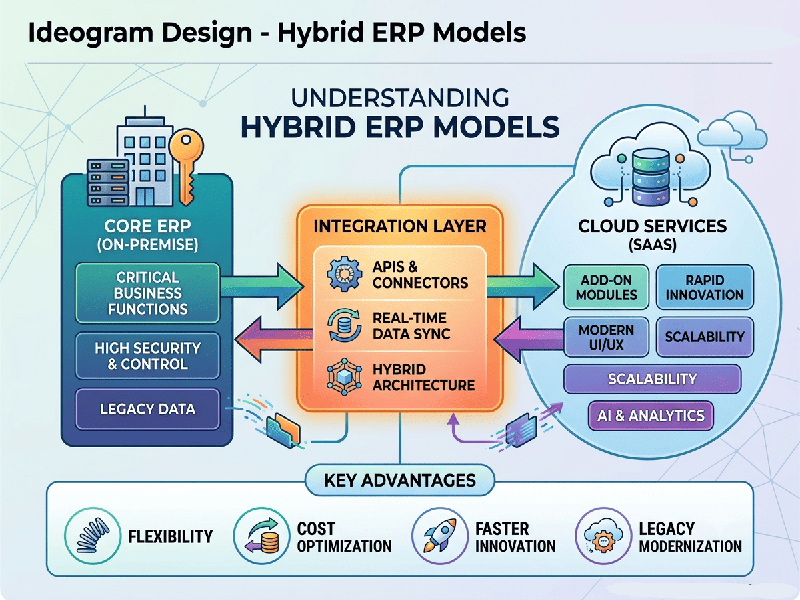
Hybrid ERP Models Explained
A Hybrid ERP (Enterprise Resource Planning) model
is a strategic architectural approach where an organization runs a mix of
on-premises software and cloud-based (SaaS) applications to manage its business
processes.
Unlike a "pure" cloud ERP (where everything
resides in the cloud) or a "legacy" on-premises ERP (where everything
resides in your own data center), a hybrid model provides a "two-tier"
or "distributed" strategy.
Why Organizations Choose Hybrid ERP
Most companies adopt hybrid models to bridge the gap
between stability and innovation. They typically keep their core transactional
system on-premises (the "Core") and add cloud-based modules (the
"Edge") for agility.
1. The "Core" (On-Premises)
Usually handles stable, mission-critical systems that
require heavy customization, strict data sovereignty, or high-performance
connectivity to factory floors.
- Examples: Manufacturing Execution Systems
(MES), heavy Finance/Accounting, and Supply Chain Management.
2. The "Edge" (Cloud/SaaS)
Handles functions that require rapid innovation,
user-friendly interfaces, and frequent updates.
- Examples: Human Resources (HRIS),
Customer Relationship Management (CRM), E-commerce, and advanced Data
Analytics.
Key Benefits
- Gradual Modernization: You don’t have to "rip and
replace" your massive, expensive legacy ERP. You can modernize piece
by piece.
- Cost Efficiency: You only pay for SaaS
subscriptions for the departments that need constant updates, while
avoiding expensive cloud egress fees for massive, stable data sets.
- Agility: You can deploy a new
cloud-based module for a specific department (e.g., a new sales platform)
in weeks rather than the months it would take to upgrade a monolithic
legacy system.
- Best-of-Breed Functionality: You can keep a reliable,
tailored core system while integrating the absolute best-in-class cloud
tools for specialized tasks.
Core Challenges to Consider
- Integration Complexity: The biggest hurdle is ensuring
the on-premises system talks to the cloud system in real-time (Data
Silos). This often requires robust middleware or API management platforms.
- Security & Compliance: Managing security protocols
across two different environments can be complex. You must ensure
consistent data governance across both physical and virtual
infrastructures.
- Total Cost of Ownership (TCO): While you save on some
licensing, you may incur higher costs for specialized IT staff who can
manage both legacy architecture and cloud integration.