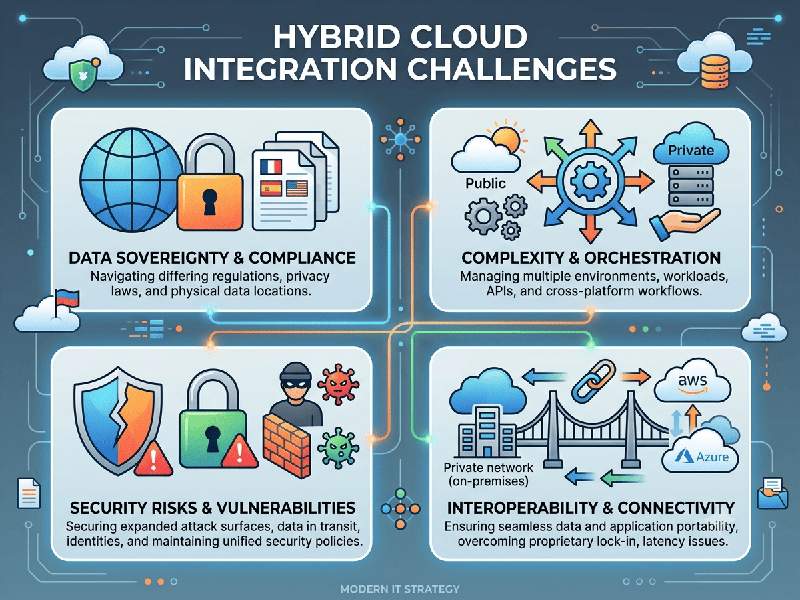
Hybrid Cloud Integration Challenges
Integrating a hybrid cloud environment—which combines
on-premises infrastructure, private clouds, and public clouds—offers
significant flexibility but introduces complex architectural and operational
challenges.
1. Data Consistency and Synchronization
Maintaining a "single source of truth" is
difficult when data resides across disparate environments.
- Latency: Real-time data synchronization
between on-premises databases and cloud storage can be hampered by network
latency.
- Data Gravity: Moving large volumes of data
(the "gravity" effect) between environments is slow, expensive,
and technically taxing.
- Data Integrity: Ensuring that data remains
consistent and uncorrupted during frequent transit between environments is
a major overhead.
2. Security and Compliance
A hybrid model expands the attack surface, as security
policies must be enforced consistently across environments that have different
control mechanisms.
- Unified Identity Management: Implementing a seamless
Identity and Access Management (IAM) framework across on-premises Active
Directory and cloud-native IAM services is complex.
- Fragmented Visibility: It is difficult to get a
holistic view of security threats when logs are scattered across different
platforms.
- Regulatory Drift: Ensuring that compliance
standards (like GDPR, HIPAA, or SOC2) are met across all nodes of the
hybrid infrastructure requires constant monitoring.
3. Complexity of Network Connectivity
Connecting on-premises infrastructure to the public
cloud requires robust, secure, and low-latency networking.
- Connectivity Reliability: Relying on the public internet
is often insufficient; organizations frequently need expensive dedicated
connections (like AWS Direct Connect or Azure ExpressRoute).
- Configuration Management: Managing routing tables,
firewalls, and VPN tunnels across different environments creates
configuration drift and increases the risk of human error.
4. Skill Gap and Operational Overhead
Managing a hybrid environment requires a specialized
skill set that covers both traditional data center hardware and cloud-native
services.
- Lack of Expertise: IT teams often struggle to
maintain proficiency in both legacy systems and modern, ephemeral cloud
architectures.
- Tool Sprawl: Teams often end up using
different sets of management tools for private and public clouds, leading
to silos and inefficient workflows.