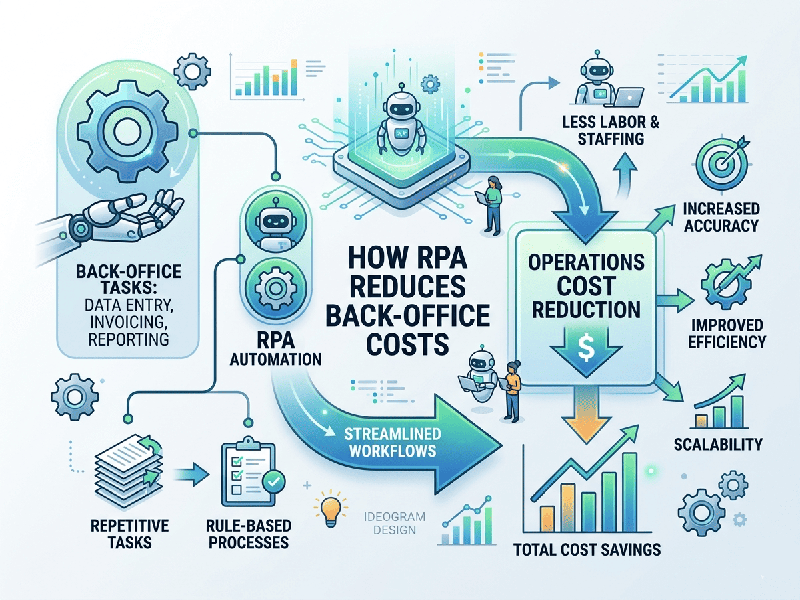
How RPA Reduces Back-Office Operations Costs
Back-office operations—including finance, human resources,
procurement, and data reconciliation—are traditionally burdened by manual,
high-volume, and rule-based tasks.
Implementing Robotic Process Automation (RPA)
transforms these workflows by deploying software "bots" that mimic
human digital actions. By executing repetitive tasks at the presentation layer
of existing software, RPA allows enterprises to achieve 25% to 50%
reductions in back-office operational costs without requiring expensive,
ground-up IT overhauls.
1. Primary Channels of Cost Reduction
RPA lowers expenditure across several core areas of
enterprise operations:
Elimination of Costly Manual Errors and Rework
Human data entry inherently carries error rates averaging 1%
to 4%. In back-office functions like Accounts Payable, a single mistyped
invoice amount or incorrect bank routing code triggers expensive audit
tracking, payment delays, and manual reconciliation. Bots execute data
transfers with 100% rule-based consistency, eliminating the labor costs
associated with fixing mistakes.
Acceleration of Throughput and Cycle Times
RPA software operates roughly 5 to 10 times faster than a
human operator and runs continuously 24/7/365 without fatigue.
- Impact: Processes like the monthly
financial close, invoice matching, or employee onboarding cycles are
compressed from days to mere hours, preventing operational backlogs and
optimizing working capital.
Headcount Avoidance During Scale
When an enterprise grows its transaction volume (e.g.,
doubling the number of daily purchase orders), a traditional back-office
requires a linear increase in administrative staff. RPA breaks this
relationship; scaling the process simply means allocating more processing
threads or virtual bots to the workload, keeping labor costs flat as revenue
grows.
Low-Friction Legacy System Integration
Replacing aging ERP systems or custom core databases costs
millions and takes years. RPA interfaces directly with existing User Interfaces
(UIs) and legacy applications. It logs in, copies data, fills out forms, and
logs out exactly like a human would, unlocking modern automation efficiencies
with minimal upfront capital expenditure (CapEx).