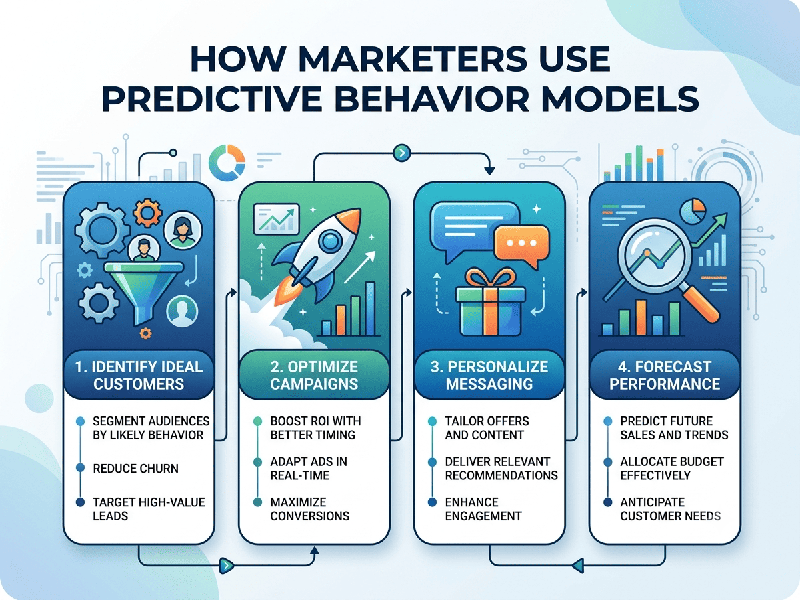
How Marketers Use Predictive Behavior Models
Predictive behavior modeling is a data-driven strategy
where marketers use historical data, machine learning, and statistical
algorithms to forecast future customer actions. By identifying patterns
in past behavior, brands can anticipate what a customer is likely to do next
and intervene with personalized messaging or offers at the exact right moment.
How the Modeling Process Works
The effectiveness of these models relies on the
"data loop":
1.
Data Collection: Gathering data from CRM systems, website interactions, purchase history,
social media engagement, and demographic information.
2.
Pattern Recognition: Using AI to find correlations (e.g., "Customers who buy product X
usually buy product Y within 14 days").
3.
Predictive Scoring: Assigning a probability score to individual users (e.g., a "Churn
Risk Score" or "Likelihood to Buy" percentage).
4.
Strategic Activation: Triggering automated marketing workflows based on these scores.
Benefits for Marketers
- Reduced Customer Acquisition
Costs (CAC): By
focusing marketing budgets on leads with the highest purchase propensity,
companies spend less on disinterested audiences.
- Hyper-Personalization: Instead of sending
"one-size-fits-all" campaigns, marketers deliver content that
feels tailor-made to the customer's immediate needs.
- Optimized Timing: Algorithms predict when
a customer is most active or likely to convert, ensuring messages arrive
when they are most effective.
- Higher Conversion Rates: Recommending the "next
best offer" increases average order value and reduces friction in the
buyer's journey.
Key Requirements for Implementation
To move from basic analytics to predictive modeling, a
business requires:
- Clean, Integrated Data: Your data must be
"unified" (the same customer identified across mobile, web, and
store systems) to build accurate models.
- The Right Tech Stack: Modern Customer Data Platforms
(CDPs) or specialized AI marketing tools are required to process the data
and generate real-time scores.
- Privacy Compliance: With increasing regulations
(like GDPR and CCPA), marketers must ensure that data is collected and
used ethically and transparently.