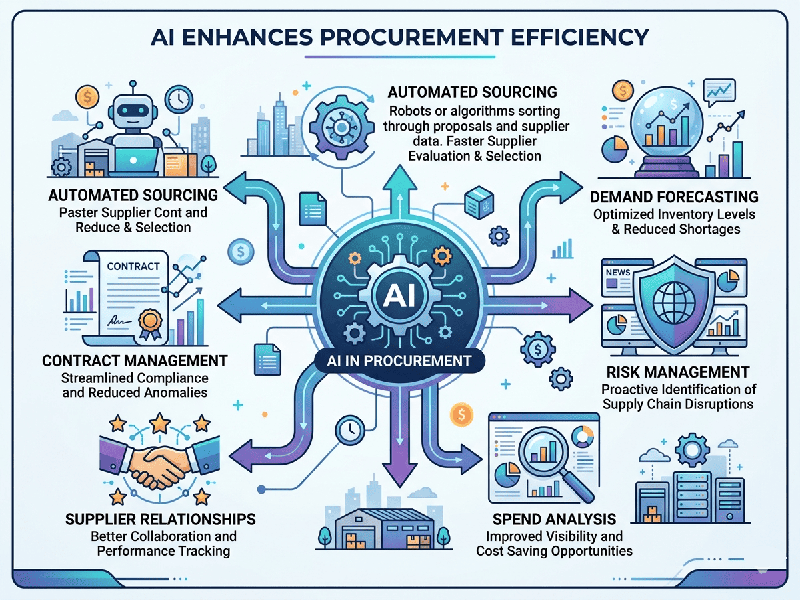
How AI Enhances Procurement Efficiency
AI is fundamentally shifting procurement from a reactive,
administrative function to a proactive, strategic one. By integrating Machine
Learning (ML), Natural Language Processing (NLP), and Predictive Analytics,
businesses are achieving significant gains in speed and cost reduction.
1. Automation of Repetitive Tasks
AI handles high-volume, low-complexity tasks that
traditionally consume hours of manual labor.
- Invoice & PO Processing: AI-enhanced OCR (Optical
Character Recognition) can extract data from invoices and match them with
Purchase Orders (POs) and receipts automatically, reducing processing time
by up to 80%.
- Autonomous Sourcing: For "tail spend"
(low-value, non-strategic purchases), AI can autonomously conduct
three-bid-and-a-buy sourcing events, managing vendor communication without
human intervention.
- Supplier Onboarding: Automated workflows verify
supplier credentials, bank details, and compliance documents, slashing
onboarding cycles from weeks to days.
2. Strategic Spend Analysis
AI processes massive datasets to identify patterns that
manual analysis would miss.
- Spend Classification: AI algorithms automatically
categorize every transaction across global ERP systems, providing a
"single source of truth" for total spend.
- Maverick Spend Detection: It flags when employees
purchase items outside of negotiated contracts, allowing procurement to
recapture lost savings.
- Opportunity Identification: AI identifies consolidation
opportunities—finding where the same item is being bought from different
vendors at different prices across the organization.
3. Predictive Risk Management
Instead of reacting to supply chain disruptions, AI helps
procurement teams anticipate them.
- Supplier Health Monitoring: AI monitors news, financial
reports, and social media in real-time to flag risks like supplier
bankruptcy, strikes, or geopolitical instability.
- Demand Forecasting: By analyzing historical
consumption alongside external variables (market trends, weather, economic
shifts), AI creates highly accurate demand models to prevent stockouts and
over-ordering.
4. Intelligent Contract Management
Natural Language Processing (NLP) allows AI to
"read" and manage thousands of legal documents.
- Clause Extraction: Quickly identifies key terms,
expiration dates, and renewal triggers across the entire contract library.
- Compliance Audits: Automatically flags contracts
that deviate from standard company templates or legal requirements.
- Negotiation Support: AI analyzes past negotiation
outcomes to suggest the best pricing or terms to seek with specific
vendors.