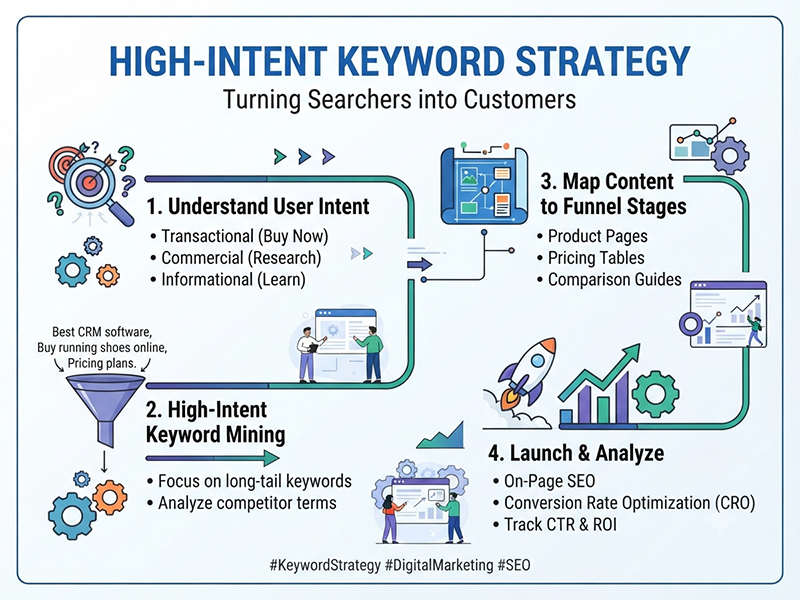
High-Intent Keyword Strategy
A high-intent keyword strategy focuses on
targeting search terms used by people who are at the bottom of the marketing
funnel—those who have moved past general research and are actively looking to
evaluate options, make a purchase, or sign up for a service.
While informational keywords (e.g., "what is
supply chain optimization") bring in high traffic volume, high-intent
keywords bring in qualified prospects ready to convert (e.g., "best SCM
software for Indian exporters with ERP integration").
Types of Search Intent to Target
- Commercial Intent: Users are comparing options or
looking for the best solutions (e.g., “top-rated cloud cost forecasting
tools”, “Agrived Foods organic product price list”).
- Transactional Intent: Users are ready to buy,
register, or take immediate action (e.g., “buy organic bulk pulses
online India”, “subscribe to ListyX directory”).
- Navigational/Brand Intent: Users are looking for a
specific brand or platform page (e.g., “Tiny Adds login page”, “Agrived
Foods wholesale portal”).
Core Steps to Build Your Strategy
1.
Analyze the Funnel & User Journey: Identify exactly where your target audience converts.
Map out what terms they type when they have budget approval, specific technical
requirements, or immediate procurement needs.
2.
Mine Competitor Gaps: Use SEO tools to find out which commercial and transactional keywords
your competitors are ranking for—and where they are missing out on localized or
niche long-tail terms.
3.
Leverage Modifier Words: Combine root keywords with high-intent modifiers to weed out
casual researchers.
o Examples: "Best," "Top,"
"Pricing," "Cost," "Near me," "Buy,"
"Software for [Industry]," or localized variations like "in
India."
4.
Optimize Bottom-of-Funnel (BoFU) Landing Pages: Ensure your product pages, pricing
sheets, comparison guides, and service directories are heavily optimized with
clear metadata, schema markup, and distinct calls-to-action (CTAs).
5.
Track Conversion Metrics, Not Just Traffic: Measure success by form fills, demo
requests, sign-ups, and pipeline revenue rather than raw organic impressions.
High-intent traffic will naturally have lower search volume but significantly
higher conversion rates.