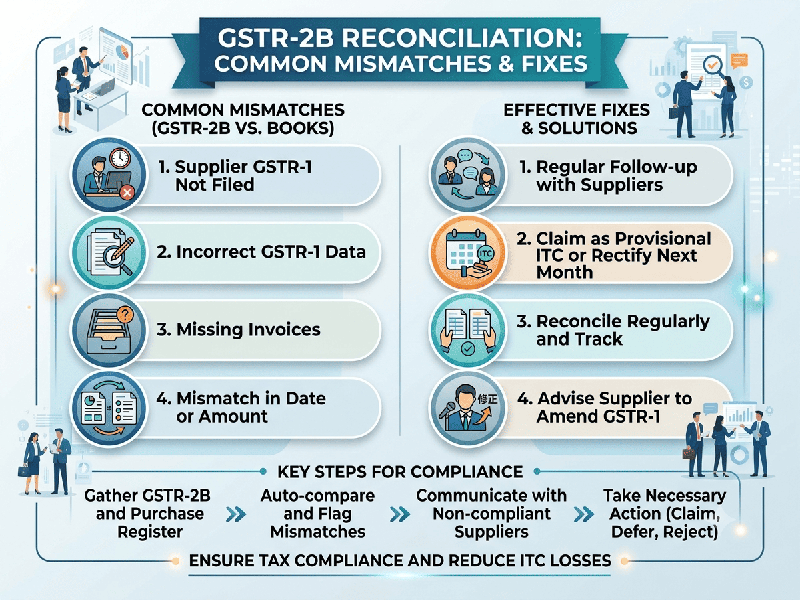
GSTR-2B Reconciliation: Common Mismatches and Fixes
GSTR-2B is an auto-drafted, static Input Tax Credit (ITC) statement
generated on the 14th of every month for every registered taxpayers. It acts as
the official benchmark for the maximum eligible ITC a business can claim in its
monthly GSTR-3B return.
Reconciling your internal Purchase Register (PR)
against GSTR-2B ensures you maximize legitimate credit claims without
triggering demand notices from the tax department for excess claims.
Key Mismatches and Solutions
1. Invoices Present in Purchase Register but Missing
in GSTR-2B
Cause: The vendor failed to file their GSTR-1, filed it after the
monthly cut-off date (11th/13th), or incorrectly selected the invoice as B2C
instead of B2B.
Impact: Claiming credit on unreflected invoices results in tax
notices under Rule 36(4).
Fix:
Action the invoice through the Invoice Management
System (IMS) on the GST portal to mark it as pending.
Send automated mismatch notifications or payment holds
to the vendor until the invoice reflects in subsequent periods.
2. Invoice Details Mismatch (Value, Tax, Invoice
Number, Date)
Cause: Typographical errors in invoice numbers (e.g., missing
slashes or zeroes), date format differences, or discrepancy in tax amounts due
to rounding off.
Impact: Automated matching software flags the record, preventing
seamless ITC auto-population.
Fix:
Configure fuzzy matching rules in your
reconciliation software (e.g., ignorable special characters, date formats, or
micro-value rounding thresholds like ±₹1–₹10).
Request the vendor to amend the record in their GSTR-1
via Table 9 if tax values or GSTIN details are mismatched.
3. Mismatched Place of Supply (POS) or GSTIN
Cause: Vendor billed using an incorrect state GSTIN or entered the
wrong Place of Supply, turning an Interstate transaction (IGST) into an
Intrastate transaction (CGST+SGST), or vice versa.
Impact: Ineligible credit under Section 16(2) due to incorrect tax
head allotment.
Fix:
Instruct the supplier to issue a Credit Note for the
incorrect invoice and re-issue a fresh invoice with correct POS/GSTIN details.
Reverse or withhold credit claims until the amended
details reflect under the correct tax heads in GSTR-2B.
4. Vendor Marked as Suspended or Cancelled
Cause: Supplier's GST registration was cancelled or suspended due
to non-filing of returns or fraud.
Impact: Invoices issued during the period of suspension/cancellation
become legally ineligible for ITC.
Fix:
Implement automated GSTIN status checks during
purchase invoice processing.
Invalidate or block ITC claims for suppliers whose
GSTINs are inactive, and hold vendor payouts pending status restoration.
5. Claiming Ineligible / Blocked Credit under Section
17(5)
Cause: Invoices for goods/services that are restricted under
Section 17(5) (e.g., motor vehicles, food and beverages, club memberships)
automatically populate into GSTR-2B as available credit.
Impact: Claiming restricted credits leads to penalty and interest
liability (18% p.a.) upon audit.
Fix:Flag ledger heads corresponding to Section 17(5) items
directly in your ERP chart of accounts.
Ensure your GST tool automatically moves these items
to the "Ineligible Credit" column in GSTR-3B rather than claiming
them.