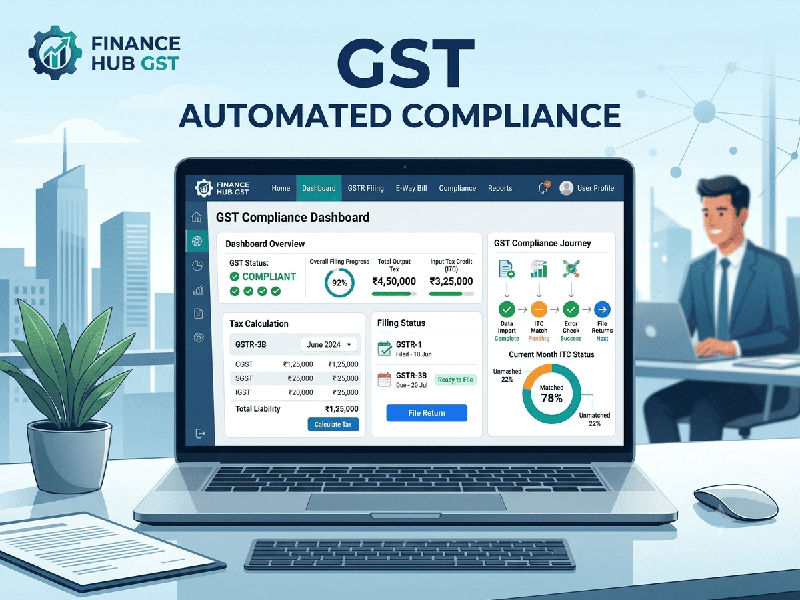
GST Compliance Automation for Indian Businesses
GST Compliance Automation refers to using specialized
software, APIs, and AI-driven systems to connect an enterprise's accounting
software or ERP (e.g., Tally, SAP, Oracle, Zoho Books) directly to the GSTN
(Goods and Services Tax Network) and the IRP (Invoice Registration
Portal).
This automation eliminates manual data entry, speeds
up tax reconciliation, prevents working capital leakage, and mitigates
compliance penalties.
Core Pillars of GST Automation
1. E-Invoicing & E-Way Bill Generation
Direct IRP Integration: Invoices generated in the ERP
automatically send payload data via API to the Invoice Registration Portal
(IRP).
Real-time IRN & QR Code: The system fetches the Invoice
Reference Number (IRN) and signed QR code in real-time without user
intervention.
Automated E-Way Bills: Transporter details are synced
directly to generate E-Way Bills alongside or directly from the e-invoice data.
2. ITC (Input Tax Credit) & IMS Reconciliation
Auto-Matching (PR vs GSTR-2B): Software runs fuzzy matching
algorithms across Purchase Registers (PR) and auto-populated GSTR-2B statements
to maximize tax credit claims.
Invoice Management System (IMS) Integration: Automatically handles vendor invoice
actions (Accept, Reject, Pending) directly on the portal to secure eligible
ITC.
Vendor Follow-Up: Automated communication (via SMS/WhatsApp/Email) is
dispatched to non-compliant vendors whose missing filings block your credit.
3. Return Preparation & Filing
Auto-Population: Sales data automatically flows into GSTR-1, and
summary data populates GSTR-3B, minimizing manual entry errors.
Validation & Rule Checks: Embedded tax rules validate HSN/SAC
codes, state-wise POS (Place of Supply) rules, and tax rate applications prior
to upload.
Multi-GSTIN Management: Consolidated filing status, tax
liabilities, and credit ledgers monitored from a single dashboard across state
branches.