GL (General Ledger) Automation in ERP
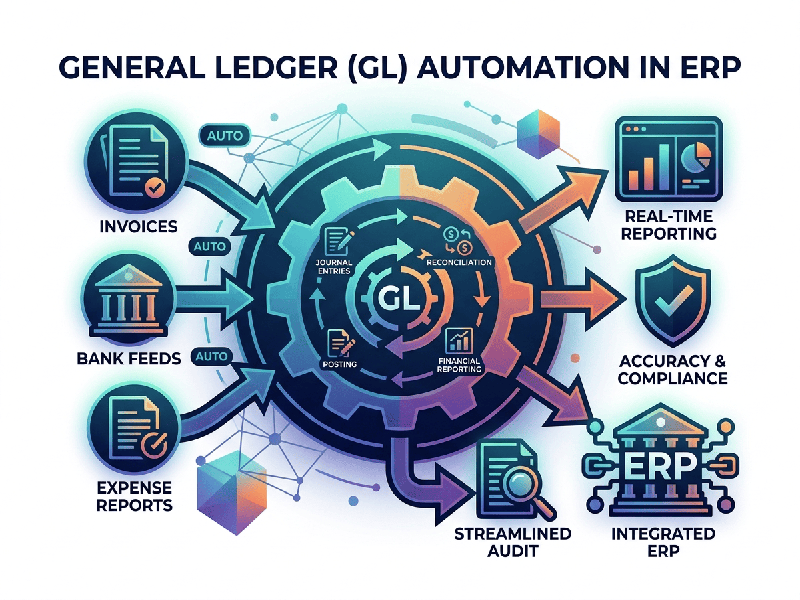
General Ledger (GL) automation in an ERP system refers to the
process of using software to streamline, validate, and record financial
transactions with minimal manual intervention. By automating the movement of
data from sub-ledgers (like Accounts Payable, Accounts Receivable, and Payroll)
into the General Ledger, organizations reduce errors, improve compliance, and
shorten the financial close cycle.
Core Components of GL Automation
- Automated Journal Entry Posting: Transactions originating in
sub-ledgers are automatically summarized and posted to the GL, eliminating
manual data re-entry.
- Bank Reconciliation: Integration with bank feeds
allows the ERP to automatically match bank transactions against internal
ledger entries, flagging discrepancies for human review.
- Recurring & Accrual
Automation: The
system automatically schedules and posts recurring entries (e.g., rent,
depreciation) and accruals, ensuring they are recorded in the correct
period without manual triggers.
- Intercompany Elimination: In multi-entity organizations,
the system automatically identifies and eliminates intercompany
transactions during consolidation.
- Real-time Validation: Automated business rules and
validation checks (e.g., ensuring a debit/credit balance, checking against
budget limits) occur before a transaction is posted.
Key Benefits
1.
Enhanced Accuracy: Eliminates human error caused by typos, calculation mistakes, or
transposition of numbers.
2.
Increased Efficiency: Reduces the time finance teams spend on transactional processing,
allowing them to focus on Financial Planning and Analysis (FP&A).
3.
Better Audit Readiness: Every automated entry leaves a digital audit trail, making
it easier to trace the origin of every figure in the GL.
4.
Continuous Accounting: Shifts the paradigm from a stressful month-end
"crunch" to a continuous process where reconciliations are performed
daily.
Challenges to Consider
- Data Integrity: Automation requires clean,
standardized data; if the input is flawed, the automated output will be
consistently wrong.
- Configuration Complexity: Setting up the initial mapping
rules and integration triggers requires significant upfront investment in
ERP configuration and testing.
- Change Management: Finance teams must shift from "doing" the entry to "reviewing" the automated output, which requires a change in skill sets and internal controls.