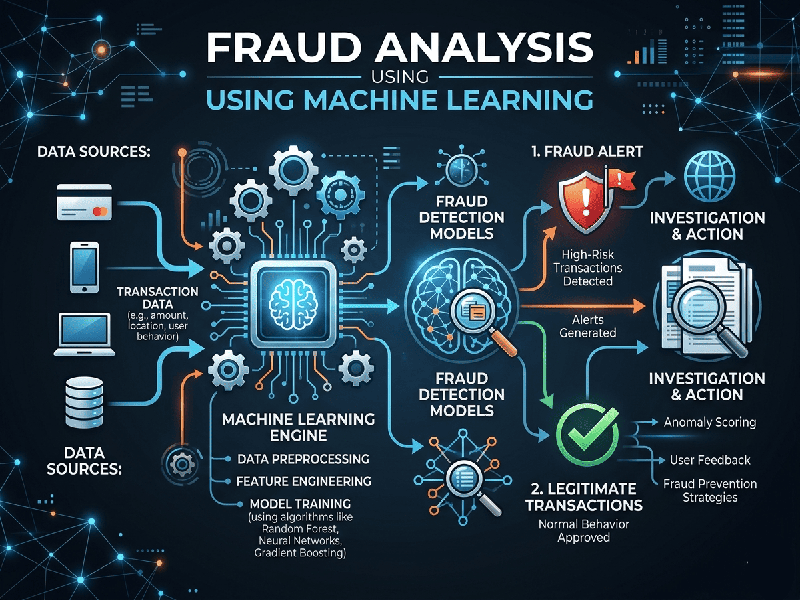
Fraud Analysis Using Machine Learning
Fraud analysis has evolved from simple rule-based systems to
sophisticated Machine Learning (ML) architectures. While rules can catch known
patterns (e.g., "flag transactions over ₹50,000"), ML identifies
subtle, evolving anomalies that human analysts might miss.
1. The Core ML Workflow for Fraud
Machine learning for fraud detection typically follows a
specific pipeline to handle the "imbalanced data" problem (where 99%
of transactions are legitimate and only 1% are fraudulent).
1.
Data Collection: Gathering transaction logs, user IP addresses, device IDs, and
historical behavior.
2.
Feature Engineering: Creating variables like "velocity" (how many transactions in
the last hour) or "geographic distance" (distance between the last
two transactions).
3.
Model Training:
Feeding labeled data (Fraud vs. Genuine) into an algorithm.
4.
Real-Time Scoring: The model assigns a "fraud score" (e.g., 0 to 1) to every new
event.
5.
Action: High
scores trigger immediate blocks or Multi-Factor Authentication (MFA).
2. Common Algorithms Used
Fraud detection isn't a "one-size-fits-all" task.
Different algorithms serve different purposes:
- Logistic Regression: Used for simple, high-speed
binary classification (Fraud or Not Fraud).
- Random Forests: Excellent for handling complex
datasets with many features. It uses an ensemble of decision trees to
reach a consensus, making it harder for "outlier" noise to trick
the system.
- Gradient Boosting
(XGBoost/LightGBM): Currently the industry favorite. It is highly efficient at finding
patterns in tabular data and handles imbalanced classes well.
- Neural Networks (Deep Learning): Used by large-scale payment
processors to detect patterns in sequence (e.g., a "warm-up"
period where a fraudster makes small purchases before a large one).
3. Supervised vs. Unsupervised Learning
Supervised Learning (The "Known" Threats)
The model is trained on historical data where fraud has
already been identified.
- Pros: Highly accurate for recurring
patterns.
- Cons: Struggles with
"Zero-Day" fraud—new types of attacks the model hasn't seen
before.