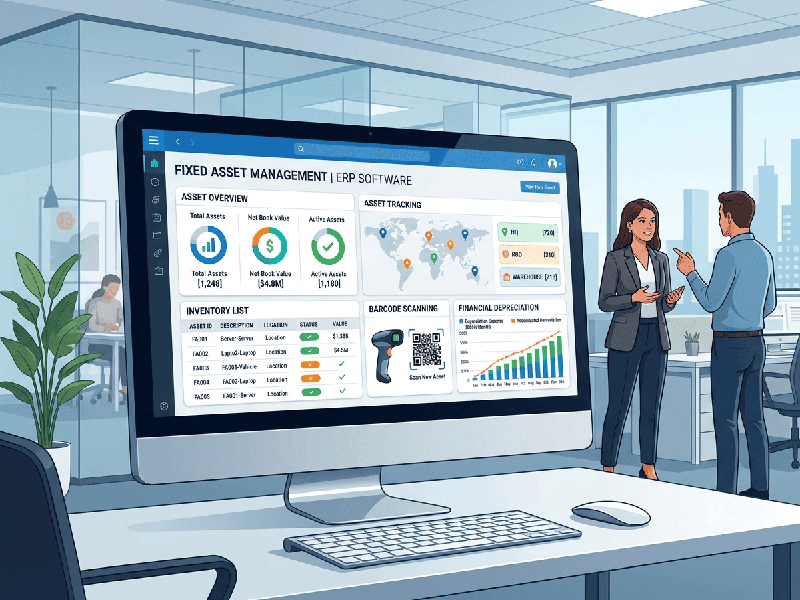
Fixed Asset Management in ERP
Managing Fixed Asset Management (FAM) within an
ERP system ensures end-to-end tracking of a company’s long-term physical
assets—from initial procurement and capitalization to ongoing depreciation,
maintenance, and eventual disposal. Proper ERP integration prevents audit
discrepancies, ensures compliance with accounting standards (GAAP/IFRS), and
optimizes asset utilization.
1. Core Objectives of ERP Fixed Asset Management
Lifecycle Traceability: Maintain a clear audit trail of
every asset's physical location, custodian, financial value, and maintenance
history.
Automated Depreciation: Eliminate manual spreadsheets by
automating multi-book depreciation calculations across financial reporting and
tax jurisdictions.
Subledger-to-GL Integration: Seamlessly bridge procurement
(Accounts Payable/Purchasing) with general ledger capitalization.
3. Fixed Asset Lifecycle Workflow
1.Phase 1: Acquisition & Creation:Procurement & Capitalization.
Purchase & Receipt: Assets are ordered via PO and
received through inventory or Accounts Payable.
Capitalization: The ERP automatically converts qualifying AP invoices or
project costs into an asset record, assigning a unique asset ID and tag number.
2.Phase 2: Assignment & Tagging:Deployment & Tracking.
Physical Tagging: Assets are labeled with barcodes or RFID tags linked
to the ERP record.
Custodian Assignment: Assign the asset to a specific
department, cost center, and physical location for accountability.
3.Phase 3: Depreciation & Maintenance:Routine Operations.
Automated Depreciation Runs: At month-end, the ERP calculates
depreciation expense across all books and posts the journal entries to the GL.
Maintenance Tracking: Log scheduled servicing, repairs,
and warranty details against the asset record.
4.Phase 4: Modification & Revaluation:Mid-Life Adjustments.
Capital Improvements: Record major upgrades that extend
useful life or increase asset value, adjusting the depreciation schedule.
Impairment / Revaluation: Adjust asset book value downward for
impairments or upward based on fair market appraisals.
5.Phase 5: Disposal & Decommissioning:Retirement & Disposal.
Disposal Processing: Record sales, scrappage, donations, or total
write-offs.
Gain/Loss Calculation: The ERP automatically calculates the
net book value against proceeds received, posting the resulting gain or loss to
the P&L.