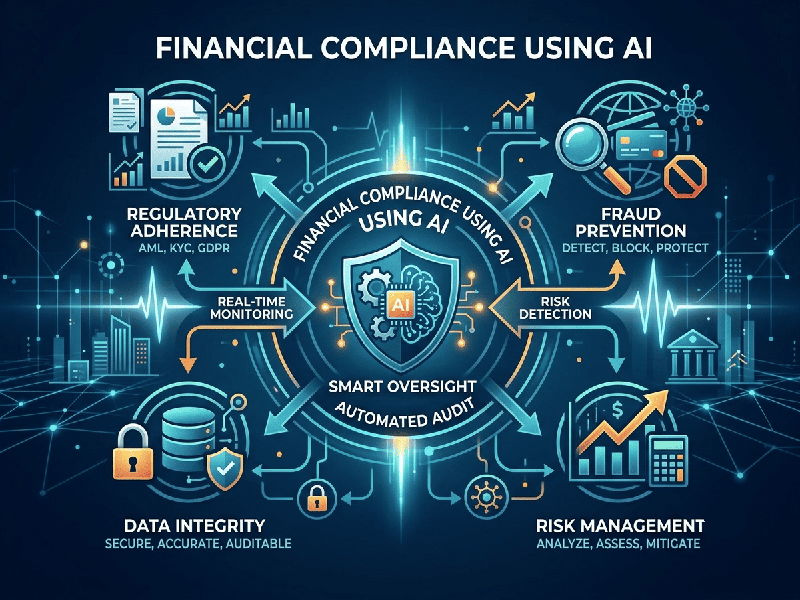
Financial Compliance Using AI
Artificial Intelligence has become a cornerstone of
modern financial compliance, transforming how organizations handle risk,
reporting, and regulatory adherence. By shifting from static, rule-based
systems to adaptive AI models, firms can now process massive datasets in
real-time to detect threats that traditional methods would likely miss.
Core Applications in Financial Compliance
AI is primarily used to automate high-volume, complex
tasks while increasing accuracy:
- Anti-Money Laundering (AML): AI replaces rigid rule sets
with machine learning models that identify "structured"
transactions (small, suspicious amounts) and flag anomalies by comparing
current behavior against established customer profiles.
- Know Your Customer (KYC) &
Onboarding:
Automated identity verification systems scan and authenticate ID documents
in seconds. AI can also perform continuous monitoring to see if a
customer's risk profile changes due to external factors (e.g., being added
to a sanctions list).
- Suspicious Activity Reporting
(SAR):
Generative AI assists compliance officers by summarizing case histories
and drafting reports, significantly reducing the administrative burden and
improving the quality of narratives submitted to regulators.
- Sanctions Screening: AI improves accuracy by using
Natural Language Processing (NLP) to match names and entities across
multiple languages and variations, drastically reducing "false
positives" that typically drain resources.
The Regulatory Landscape in India
In India, the approach to AI in finance is currently pro-innovation
but increasingly focused on responsible governance:
- RBI Framework: The Reserve Bank of India’s FREE-AI
(Framework for Responsible and Ethical Enablement of AI) committee
report emphasizes seven principles: trust, people-first, innovation,
fairness, accountability, transparency, and safety.
- Data Protection: The Digital Personal Data
Protection Act, 2023 sets strict obligations on "data
fiduciaries" regarding consent, security, and algorithmic audits for
bias.
- Accountability: While there is no single
"AI Law," existing legislation (IT Act 2000, Consumer Protection
Act 2019) is being interpreted to cover AI-driven risks like deepfakes and
algorithmic bias.
- Governance: Institutions are expected to
implement Explainable AI (XAI), ensuring that any decision made by
an AI (such as denying a loan or flagging a transaction) can be understood
and justified to auditors.
Strategic Risks & Management
While AI offers immense value, it introduces new
vulnerabilities:
1.
Model Risk:
Poorly trained or biased models can lead to discriminatory outcomes in lending
or risk scoring.
2.
Regulatory Gaps: Technology often moves faster than law; compliance teams must conduct
regular audits to ensure their AI isn't inadvertently violating updated
standards.
3. Adversarial AI: Criminals now use AI to generate deepfakes or synthetic identities to bypass KYC. Institutions must invest in "Anti-Fraud AI" to counter these threats.