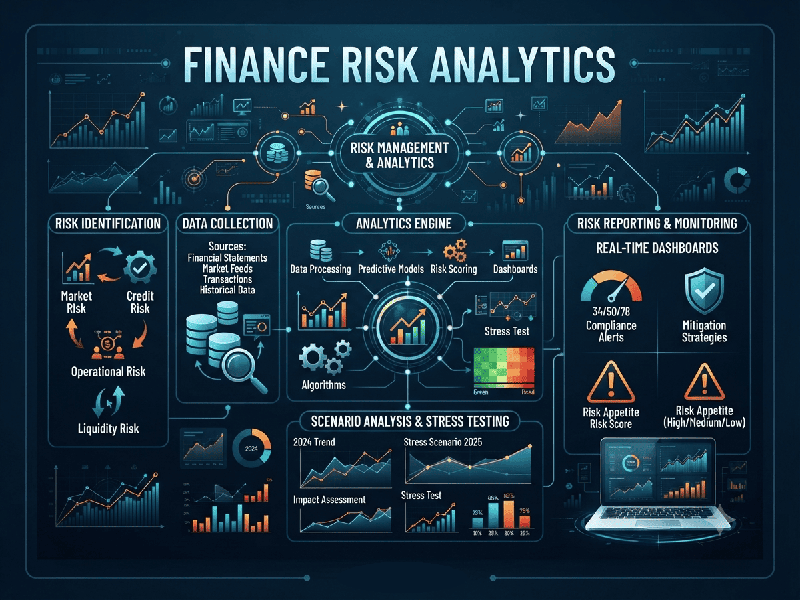
Finance Risk Analytics
Finance risk analytics combines historical financial
data, predictive modeling, and real-time market signals to identify, quantify,
and mitigate financial vulnerabilities. In competitive B2B markets and
capital-intensive sectors—such as agricultural exports and food
processing—proactive risk analytics protects profit margins against currency
volatility, credit defaults, and macroeconomic shifts.
Core Pillars of Finance Risk Analytics
To build a comprehensive risk management framework,
organizations focus on four primary analytical pillars:
- Credit Risk Assessment: Evaluating the financial
health, credit scores (such as CIBIL), and payment history of buyers and
suppliers to minimize default probabilities.
- Liquidity and Cash Flow Risk
Modeling:
Simulating various cash flow scenarios to ensure the business can
comfortably service debt obligations, manage EMIs, and sustain operational
expenses during revenue fluctuations.
- Market and Currency Risk
Analytics:
Monitoring macroeconomic indicators, central bank policies (e.g., RBI rate
adjustments), and foreign exchange fluctuations that impact international
trade margins and input costs.
- Operational & Supply Chain
Financial Risk:
Quantifying the financial impact of supplier disruptions, delayed
shipments, or quality rejections on overall working capital.
Key Analytical Techniques and Models
1. Predictive Credit Scoring and Behavior Modeling
- Advanced Analytics: Moving beyond static credit
checks by utilizing machine learning algorithms to analyze transaction
patterns, invoice payment velocity, and industry-specific credit behavior.
- Dynamic Limit Setting: Automatically adjusting credit
terms or credit lines for B2B partners based on real-time risk scores.
2. Scenario Planning and Stress Testing
- What-If Modeling: Simulating severe macroeconomic
shocks—such as sudden supply chain bottlenecks, interest rate hikes, or
spikes in raw material costs—to evaluate balance sheet resilience.
- Liquidity Buffer Optimization: Determining the optimal cash
reserves required to maintain operations without relying heavily on
high-cost short-term debt.
3. Real-Time Risk Dashboards
- Integrated Data Feeds: Combining ERP financial data,
bank feeds, and macroeconomic data into centralized dashboards.
- Early Warning Systems (EWS): Setting automated alerts for
threshold breaches, such as a sudden drop in a key supplier's financial
stability index or unusual delays in accounts receivable collection.