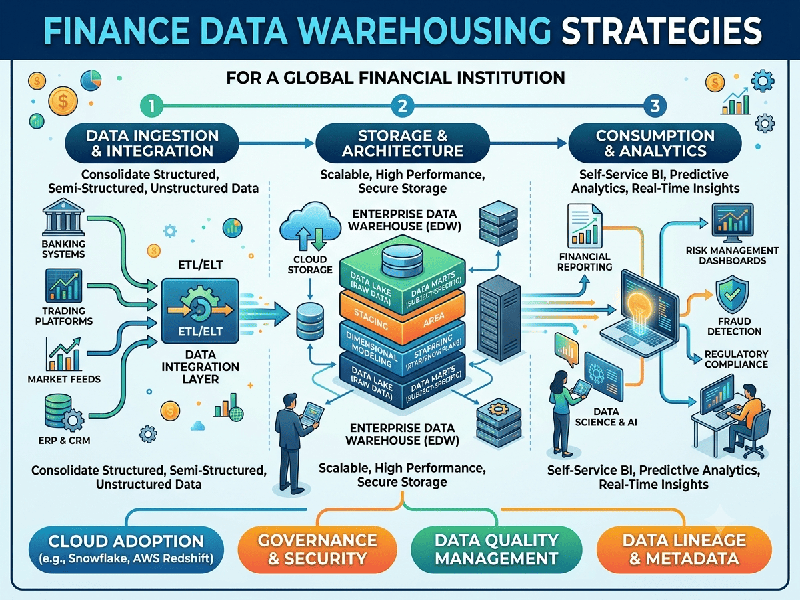
Finance Data Warehousing Strategies
Implementing a robust finance data warehousing
strategy requires moving beyond simple data storage to create a highly
optimized, secure, and scalable "single source of truth." A modern
financial data warehouse must handle high-velocity transactions, support
complex predictive modeling, and maintain strict regulatory compliance.
1. Cloud-Native Architecture & Cost Optimization
Transitioning from rigid on-premise servers to
cloud-native data warehouses (like GCP BigQuery or Azure Synapse Analytics) is
foundational.
- Separation of Compute and
Storage: This
allows you to scale storage for massive historical ledgers independently
from the computing power needed for complex end-of-month reporting.
- Cost Forecasting: Implement strict resource
tagging and quota management to enable accurate cloud cost forecasting.
This ensures compute-heavy analytical queries don't lead to unexpected
budget overruns, helping you lock in operational savings and protect your
bottom line (₹).
2. Seamless ERP & Core System Integration
Financial reporting is only as good as the data
feeding it. Your data warehouse must pull seamlessly from disparate sources
without bottlenecking daily operations.
- Change Data Capture (CDC): Instead of heavy overnight
batch loads, use CDC to stream real-time financial data from your ERP,
CRM, and supply chain management systems. This requires careful ERP
performance tuning to ensure the transactional systems aren't slowed down
by continuous data extraction.
- Unified Master Data Management: Standardize definitions across
the board. Revenue, tax liabilities, and inventory costs must mean the
exact same thing whether the data originated from a local supplier
database or an international export log.
3. AI/ML Readiness for Advanced Financial Modeling
A modern data warehouse should not just report on the
past; it must predict the future. Structure your data lakes and warehouses to
feed clean, formatted data directly into machine learning pipelines.
- Predictive Analytics: Optimize tables to support AI
models that forecast cash flow, monitor credit health (such as regional
CIBIL trends), or model the impact of fluctuating EMIs and interest rates.
- Model Monitoring: Build feedback loops into the
warehouse to track AI model performance over time, ensuring your financial
forecasts remain accurate as market conditions shift.
4. Granular Governance and Regulatory Compliance
Financial data requires the highest level of security
and auditability.
- Role-Based Access Control
(RBAC):
Implement strict row-level and column-level security. A regional manager
should only see regional data, while PII (Personally Identifiable
Information) can be masked dynamically.
- Regulatory Alignment: Design your data models to
automate compliance reporting. The schema should easily generate the exact
formats required by national regulatory bodies (like RBI policies) or
international trade agreements, reducing manual compliance overhead.
5. Strategic Data Modeling
Choosing the right structural design impacts query
speed and ease of use.
- Data Vault 2.0: Highly recommended for the
foundational layer of finance warehouses, as it provides an immutable
historical record of all transactions (essential for auditing).
Star Schema (Dimensional Modeling): Use this for the presentation layer (data marts) where the data is consumed. It simplifies the data for business intelligence tools, allowing financial analysts to slice and dice revenue by region, product, or quarter in seconds.