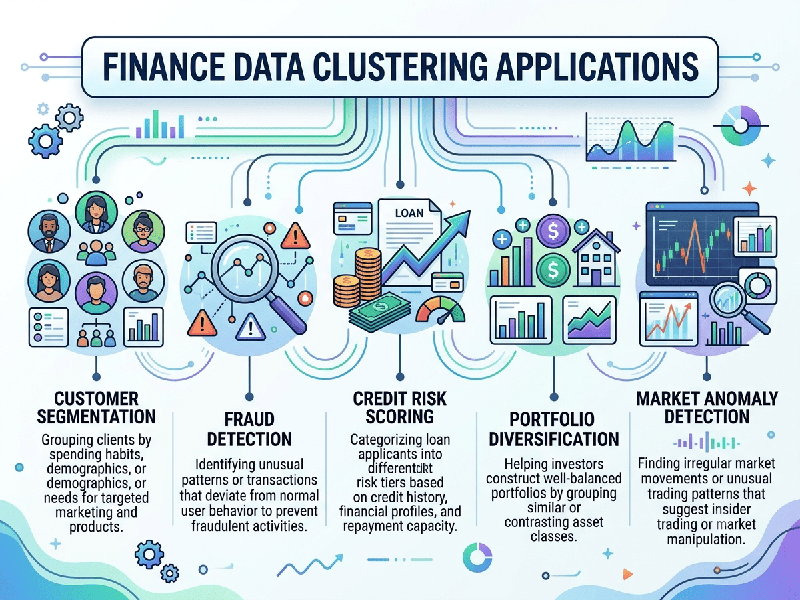
Finance Data Clustering Applications
Data clustering is an unsupervised machine learning
technique that groups unlabelled financial data based on similarities and
hidden patterns. In finance and banking, clustering helps institutions make
sense of vast, complex datasets without relying on predefined categories.
The primary applications of data clustering in the
financial sector include:
1. Customer Segmentation & Wealth Management
- Behavioral Targeting: Grouping retail or corporate
banking clients based on spending habits, transaction volumes, digital
channel usage, and income streams.
- Tailored Product Delivery: Financial institutions use
these segments to offer customized credit card rewards, personalized
investment portfolios, or targeted loan options, improving customer
lifetime value.
2. Fraud Detection & Outlier Analysis
- Normal Behavior Profiling: Clustering algorithms map
"normal" patterns of user activity (e.g., standard login
locations, typical purchase amounts, recurring transfer types).
- Anomaly Flagging: Transactions or account
behaviors that fall far outside established clusters are immediately
flagged as potential fraud, insider trading, or account takeovers.
3. Portfolio Optimization & Asset Allocation
- Asset Correlation Grouping: Clustering equities, bonds, and
alternative assets based on volatility, historical returns, and
macroeconomic sensitivity.
- Risk Diversification: Portfolio managers use these
clusters to ensure funds are distributed across genuinely uncorrelated
assets rather than superficially different options within the same
industry sector.
4. Credit Scoring & Risk Tiering
- Borrower Profiling: Clustering loan applicants or
small-to-medium enterprises (SMEs) based on financial health indicators,
leverage ratios, cash-flow variability, and repayment histories.
- Automated Underwriting: Helps risk teams categorize
applicants into precise risk brackets for automated loan approvals and
dynamic interest rate pricing.
5. Private Company Benchmarking & Valuation
- Peer Group Discovery: Because private companies lack
public market tickers, clustering models utilize financial ratios or text
embeddings (from business descriptions and registry data) to group similar
private firms.
- Venture Capital & M&A: Enables analysts to benchmark
startup performance, evaluate relative valuations, and map out competitive
market landscapes.
6. Anti-Money Laundering (AML)
- Transaction Network Clustering: Grouping complex webs of
transactions to spot structural anomalies, layering techniques, or illicit
fund-transfer rings that evade traditional rule-based filters.