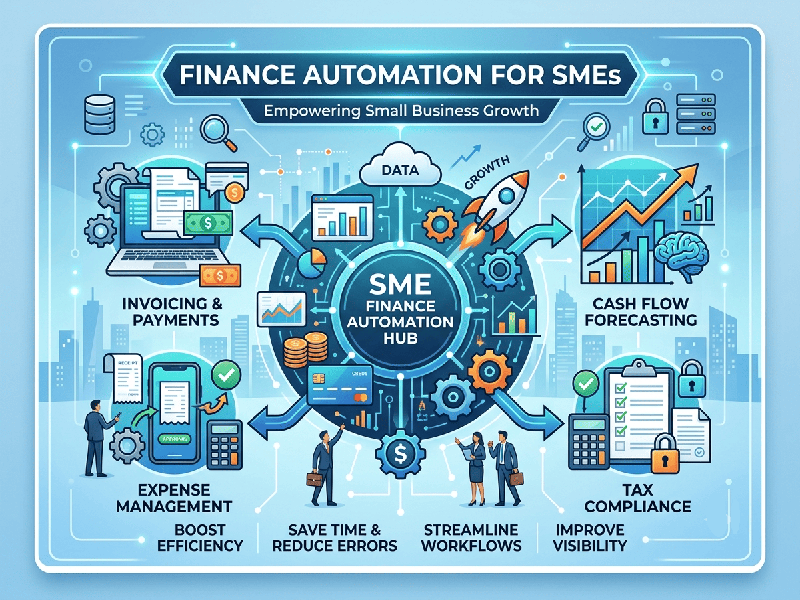
Finance Automation for SMEs
Finance automation for SMEs (Small and Medium-sized
Enterprises) involves using technology to streamline routine financial tasks,
reduce manual data entry, and improve the speed and accuracy of financial
operations. By moving away from manual spreadsheets and paper-based processes,
SMEs can free up their teams to focus on strategic growth rather than
administrative maintenance.
Key Financial Processes to Automate
The most effective automation targets repetitive,
high-volume, and rule-based tasks.
- Accounts Payable (AP): Automate the entire
workflow—from receiving digital invoices and matching them against
purchase orders to initiating vendor payments and logging the transaction.
- Accounts Receivable (AR): Automate the generation and
delivery of invoices, real-time tracking of payment status, and the
scheduling of automated reminders for overdue accounts.
- Bookkeeping &
Reconciliation:
Utilize tools that sync directly with your bank accounts to automatically
categorize transactions, match receipts to expenses, and reconcile bank
statements.
- Expense Management: Employees can use mobile apps
to scan receipts, which are then automatically categorized, submitted for
approval, and synced with accounting software.
- Payroll & Tax Compliance: Automate calculations for
salaries, benefits, and tax withholdings, ensuring timely payments and
adherence to changing tax regulations.
- Financial Reporting: Generate real-time dashboards
and reports (e.g., cash flow statements, P&L) without having to
manually export data into spreadsheets.
The Strategic Value
Implementing finance automation provides several
measurable benefits:
1.
Increased Efficiency: Drastically reduces the time spent on manual entry, allowing finance
teams to focus on financial planning and analysis (FP&A).
2.
Higher Accuracy: Eliminates human errors—such as typos in invoice amounts or duplicate
entries—that often lead to costly financial discrepancies.
3.
Improved Cash Flow: Faster invoicing and automated payment reminders help reduce Days Sales
Outstanding (DSO), ensuring the business is paid faster.
4.
Better Decision Making: Real-time visibility into the company’s financial health
enables leadership to make data-driven decisions rather than relying on stale,
month-old reports.
5.
Enhanced Security & Compliance: Centralized, cloud-based systems offer better audit
trails, encryption, and protection against fraud compared to scattered paper
records.
Implementation Best Practices for SMEs
Successful automation is less about the technology and
more about the strategy.
- Audit Before Automating: Never automate a broken
process. First, map your current workflows, simplify them, and ensure they
are efficient.
- Start Small: Don't attempt a full-scale
transformation. Identify one high-impact, low-complexity "quick
win"—such as automating overdue invoice reminders—to build momentum.
- Prioritize Integration: Ensure your chosen tools
integrate seamlessly with your existing core accounting or ERP software to
create a single source of truth.
- Manage Change: Invest in training for your
team. Position automation as a tool that empowers them to do more
fulfilling, higher-value work rather than a replacement for their roles.